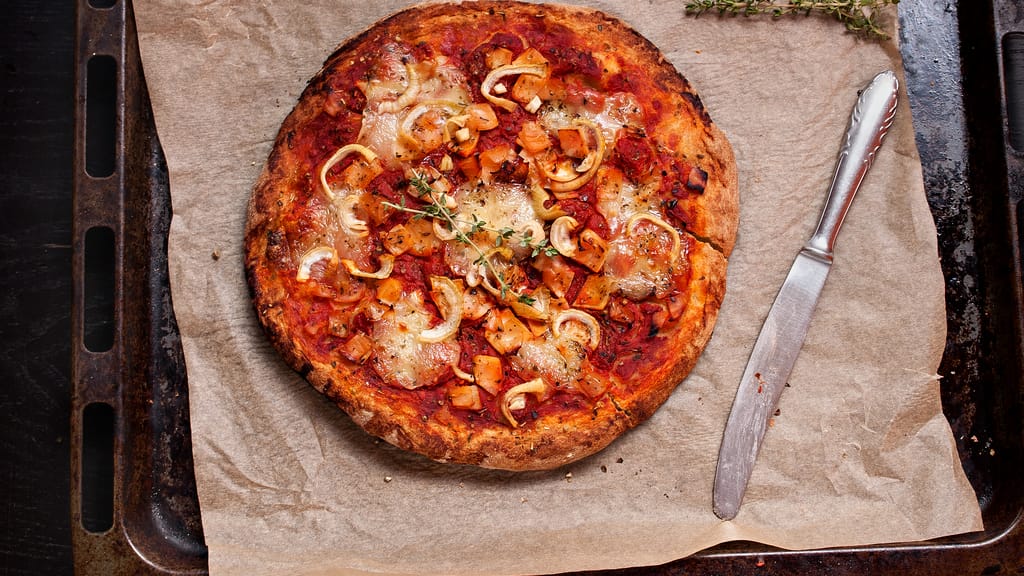
Yogurt dough pizza
No-Yeast Pizza Dough Without Rising: How to Keep It From Turning Into a Cracker
Updated Oct 17, 2026
You can make no-rise pizza dough from flour, baking powder and a liquid – plain yogurt works best – and have it on the baking sheet in 15 minutes. Baking powder stands in for yeast and lifts the dough in the oven. To keep it from turning dry and cracker-like, you need three things: oil in the dough, a thickness of 3–4 mm (about 1/8 inch), and an oven as hot as it goes for as short a time as possible.
Without yeast the dough doesn't rise, so the bubbles have to come from a chemical reaction: baking powder releases carbon dioxide as soon as it meets moisture, and again in the hot oven. An acidic liquid (yogurt, kefir, buttermilk) boosts the reaction and makes the dough softer.
What you give up: the flavor of fermentation and the airy, chewy edges of a classic pizza. Risen dough has gluten developed over hours of resting; quick dough doesn't, so it turns out denser and closer to a flatbread. Oil has to supply the softness and a very hot oven the crispness – the whole method below is built on that.
If you have time, go with the classic. For how to make yeast dough, how much water to use and how long to let it rise, see our article Pizza Dough: How Much Water, Which Flour and How Long to Let It Rise.
For most homemade pizzas, choose the yogurt dough. The baking powder and water version is the crispiest, and the quark version is the softest.
Yogurt – the softest all-rounder after quark, with a mild tang, and it can be rolled thin.
Baking powder and water – the most neutral flavor and the crispiest result, but the easiest to dry out. It needs more oil.
Quark – the softest, almost cake-like, and it can't be rolled thin. More of a "pizza flatbread" than a pizza.
Yogurt dough and water dough use the same ratio: for 250 g of flour, 1 heaped teaspoon (about 6 g) of baking powder and ½ teaspoon of salt – that matches the amount on a standard packet (12 g per 500 g of flour). Quark dough is the exception: it uses only 120–150 g of flour, so 1 level teaspoon (about 4 g) is enough. More baking powder won't make the dough rise more – it just gives it a soapy, bitter aftertaste.
Yogurt dough is the most reliable no-rise pizza dough: the acid in the yogurt reacts with the baking powder, and the fat in it keeps the dough soft.
250 g all-purpose flour (semi-coarse if you can find it)
180–220 g plain yogurt (full-fat, not low-fat)
1 heaped teaspoon (about 6 g) baking powder, ½ teaspoon salt
2 tablespoons olive oil
How much yogurt you need depends on how thick it is – Greek yogurt calls for the upper end, thinner yogurt the lower. The right dough is smooth and slightly sticky on your fingers, but doesn't stick to the bowl. You'll find the full method using this base in the recipe below.
Yogurt dough pizza
No-rise yogurt dough pizza – ready in half an hour
You can make pizza dough with baking powder and water without any yogurt, but it needs more oil, or you'll end up with a cracker.
250 g all-purpose flour (semi-coarse if you can find it)
140–150 ml lukewarm water
3 tablespoons olive oil
1 heaped teaspoon (about 6 g) baking powder, ½ teaspoon salt
This crust is the thinnest and crispiest, but also the blandest. A pinch of sugar, dried oregano right in the dough, or a crust brushed with garlic oil will help. Flatbreads like pan-fried naan without yeast work on the same principle.
Quark dough is the quickest, but also the softest – it's more of a thick batter than a dough you can roll.
250 g soft quark (or farmer's cheese)
1 egg
120–150 g plain flour
1 level teaspoon (about 4 g) baking powder, ½ teaspoon salt
Don't roll it out. Spread it with a wet spatula on parchment paper to 5–6 mm (about ¼ inch). Always par-bake the crust (8–10 minutes) before adding toppings, or the middle stays raw. Don't expect a crispy base – quark releases moisture, and the result is soft like a savory tart.
No-yeast pizza most often dries out for four reasons: too much flour when rolling, no fat, a low oven temperature with a long bake, and dough that hasn't rested.
Too much flour. Sprinkling flour while rolling can easily add 30–50 g extra to the dough. Roll on parchment paper or a lightly oiled surface, not in a heap of flour.
No fat. Without the gluten network that rising creates, fat is mostly what keeps the dough soft. 2–3 tablespoons of oil per 250 g of flour is not too much.
Low heat, long bake. 20 minutes at 200 °C (400 °F) dries the dough out before it bakes through. You want 250 °C (480 °F) or your oven's maximum, and 10–12 minutes in total.
The dough didn't rest. The dough doesn't rise, but 10 minutes of resting under a tea towel relaxes the gluten – so it doesn't spring back, you can roll it thinner with less flour, and it won't be rubbery.
Roll yogurt dough and baking powder dough to 3–4 mm (about 1/8 inch): thinner and quick dough quickly turns into a cracker, thicker and it stays sticky in the middle, because without rising it doesn't bake through as easily.
For a 30 cm (12-inch) pizza, count on 200–250 g of dough.
Leave the edge 1–2 mm thicker and brush it with oil so it doesn't brown until hard.
Move the dough onto parchment paper before adding toppings. Once topped, it shrinks and tears.
Spread quark dough to 5–6 mm (about ¼ inch); anything thinner won't hold together.
Crispy yeast-free pizza needs a scorching-hot base and a par-baked crust:
Heat your oven to 250 °C (480 °F), top and bottom heat, for at least 20–30 minutes, with a baking sheet or pizza stone inside. If you don't have a stone, a baking sheet turned upside down will help.
Slide the dough on its paper onto the hot sheet and par-bake for 4–5 minutes with no toppings, until it starts to bubble and set.
Add the tomato sauce in a thin layer (about 3–4 tablespoons for a 30 cm pizza), and tear the mozzarella and let it drain. Wet toppings are the quickest route to a soggy middle.
Finish baking for 6–8 minutes on the lower half of the oven, until the bottom is golden and the cheese starts to brown.
For topping ideas and sauces that go with it, browse our Italian cuisine section.
For a full baking sheet (about 30 × 40 cm), double the yogurt or water batch – that's 500 g of flour and 1 packet (12 g) of baking powder. Roll the dough straight out on parchment paper cut to the size of the sheet, par-bake for 6–7 minutes, then add toppings and finish baking for 10–12 minutes at 230–250 °C (445–480 °F).
A sheet pan has a greater risk of a soft middle, because the pan doesn't transfer as much heat as a stone. So go even lighter on the toppings and put the pan on the lowest rack. If you want to compare the result with a risen version, our recipe for classic pizza from yeast dough is below.
The perfect homemade pizza
The perfect homemade pizza from yeast dough – for comparison, when you have the time
Don't make the raw dough ahead of time – baking powder starts reacting as soon as it meets the liquid, and after a few hours in the fridge it loses some of its power. The best thing to freeze is a par-baked crust: wrap it in plastic wrap and it keeps for about a month. Top it and finish baking straight from frozen.
You can use baking soda instead of baking powder, but only with an acidic liquid (yogurt, buttermilk) – about ½ teaspoon per 250 g of flour. Baking soda needs acid to activate. With plain water it won't lift the dough and will leave a bitter, soapy taste.
Yes, you can make no-rise pizza with gluten-free flour, but the dough is more fragile and can't be rolled thin. Mix a gluten-free baking blend with yogurt, add an extra tablespoon of oil and spread the dough on parchment paper to 4–5 mm (about 3/16 inch). Always par-bake the crust.
Yes. Roll yogurt dough or baking powder and water dough to the size of your pan and cook it in a dry or lightly oiled pan over medium heat for 3–4 minutes, until the bottom turns golden. Then flip it, add your toppings, cover with a lid and cook for another 4–5 minutes, until the cheese melts.
Replace yogurt with the same amount of kefir, buttermilk or sour cream thinned with a little water. For a dairy-free version, use water with a tablespoon of lemon juice and add 1 extra tablespoon of oil so the dough doesn't dry out.
One recipe worth heating the oven for, one tip, and one deal from the shop. Nothing else.