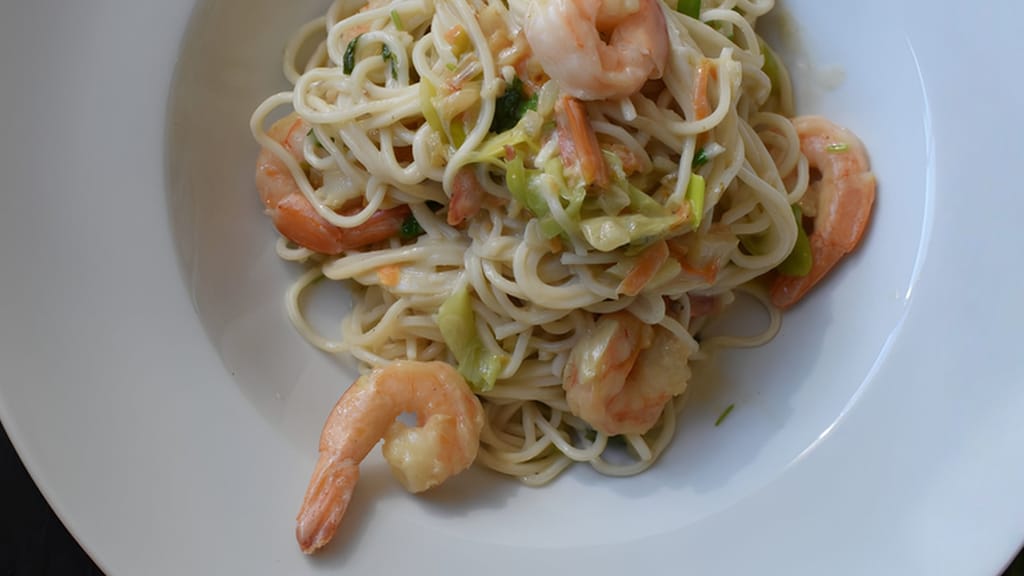
Shrimp in coconut milk
How to Cook Shrimp, Mussels and Octopus So They Aren't Rubbery
Updated Nov 17, 2026
How to cook shrimp, mussels and octopus so they aren't rubbery: shrimp 2–3 minutes in boiling salted water, mussels covered until they open (4–6 minutes), and octopus either just blanched or simmered gently for 45–90 minutes. Rubberiness almost always comes down to timing, not the recipe. You overcook shrimp and mussels with one extra minute, while with octopus the mistake is taking it out too soon. Below you'll find times for raw and frozen, cleaning, how to tell when they're done, and the safety rules for spotting mussels you must throw away.
Raw shrimp take 2–3 minutes, mussels are cooked covered until they open (usually 4–6 minutes), and an octopus of about 1 kg (2.2 lb) needs 45–60 minutes at a gentle simmer. The times for shrimp and octopus come from kitchen practice and manufacturers' package instructions; the mussel rule comes from US FDA guidance:
Raw shrimp (gray, translucent): 2–3 minutes in boiling salted water, large tiger shrimp 3–4 minutes.
Frozen raw shrimp: thaw and cook as raw, or drop them in frozen and add roughly 1–2 minutes.
Frozen, already cooked shrimp (pink): don't cook them, just thaw them or heat for about a minute, as the manufacturer's package says.
Mussels in the shell: covered, until they open, in practice 4–6 minutes. Per the FDA, discard any that don't open.
Baby octopus: either 1–2 minutes at a hard boil, or 30–45 minutes at a gentle simmer.
Octopus of about 1 kg (2.2 lb): roughly 45–60 minutes at a gentle simmer, larger ones up to 90 minutes. You'll know it's done by a skewer, not the clock.
For most seafood, the US FDA gives a safe minimum of 63°C (145°F) inside. For shrimp and mussels, go by appearance instead of temperature: a shrimp is firm and opaque, a mussel is open. Shrimp reach the safe minimum long before they turn rubbery.
Seasonal baking plans, tested recipes and kitchen tricks that save you time. Unsubscribe in one click.
Shrimp and mussels turn tough when you cook them too long. Octopus turns tough when you cook it too briefly. The difference comes down to how the meat is built.
Shrimp and mussels have delicate muscle proteins with almost no connective tissue. Heat makes them contract quickly and squeeze out water. A few seconds too long and a juicy bite becomes chewing gum. So the rule is: briefly, at a rolling boil, and straight out.
Octopus is full of collagen. It first tightens and toughens, and only with longer gentle simmering does it gradually turn to gelatin. Between "barely blanched" and "tender" there's a stage where octopus is at its toughest, and that's where most people take it out.
With octopus, choose one of two routes: either a lightning-fast blanch (small pieces only) or a long, slow simmer. Anything in between ends up like chewing gum.
To cook shrimp, drop them into a large pot of briskly boiling salted water (about a tablespoon of salt per liter, or quart), leave them 2–3 minutes and drain right away. The water shouldn't stop boiling much after they go in, so cook in batches and use a large pot.
You can add a lemon slice, a bay leaf or a few peppercorns to the water. It adds more flavor to shrimp in the shell than to peeled ones.
To clean a shrimp, peel off the shell, pull off the tail or leave it on, and remove the vein, the dark line along the back.
Twist off the head, if the shrimp has one. Save the heads and shells, as they make a great stock.
Peel the shell off with your fingers, from the legs toward the back. Leave the tail on if you're serving the shrimp with a dip.
With a sharp knife, cut along the back about 3 mm (⅛ in) deep and lift out the dark vein with the tip. It's the intestine. It isn't dangerous, but it can be gritty and bitter.
Rinse under cold water and pat dry.
Raw shrimp take 2–3 minutes, frozen raw ones 1–2 minutes longer, and precooked (pink) ones aren't cooked at all, just warmed for 1 minute. So first work out which kind you have:
Raw shrimp are gray to gray-blue and translucent. Cook them 2–3 minutes (large ones 3–4).
Precooked shrimp are already pink-orange. The manufacturer cooked them before freezing, so you only need to thaw them or stir them into a warm sauce for 1 minute at the end. Cook them again and they'll definitely be rubbery.
Frozen raw shrimp can be cooked straight from frozen. Allow about 1–2 minutes extra, and remember that frozen shrimp cool the water, so don't put too many in the pot at once.
On packs of frozen shrimp, the weight stated is usually the net weight without glaze, meaning without the ice crust that protects the shrimp. Under the EU Food Information Regulation (1169/2011), the ice isn't counted in the weight, so a 400 g pack with glaze really does give you about 400 g of shrimp once thawed.
A shrimp is done when it turns pink and is firm, pearly white and opaque inside. The US FDA gives this sign.
A C shape means the shrimp is cooked just right. An O shape, curled into a ring, means it's overcooked.
If you're not sure, cut open the thickest shrimp. There must be no gray translucent streak left in the middle.
Stop the cooking right after draining. Either tip them into a bowl of ice water (for salad) or stir them straight into a warm dish (a sauce). In a colander they keep cooking in their own heat.
Cooked shrimp shine in shrimp in coconut milk, where you stir them in at the last moment, or chilled in an Asian salad with mango and shrimp.
Shrimp in coconut milk
Shrimp in coconut milk: add the shrimp at the very end to keep them juicy
Mussels are cooked by steaming. Put them in a wide pot with about 1–2 cm (½–¾ in) of simmering liquid (water, white wine or stock with garlic and shallot), cover with a lid and leave them over high heat until they open. Shake the pot once or twice in the middle so the top layer gets to the steam.
Very little liquid is enough. Mussels release their own salty juices, and those are the best part of the sauce. So don't salt much until you've tasted the liquid.
To clean mussels, rinse them under cold running water, pull out the beard and scrape the buildup off the shells.
Tip the mussels into the sink and rinse under cold running water. Don't leave them soaking long in fresh water. They're sea creatures and die in fresh water.
Grip the beard (byssus, the tuft of fibers a mussel uses to cling to rocks) between your fingers and pull it sharply toward the hinge of the shell. Do this just before cooking, because the mussel dies soon afterward.
Scrape barnacles and bits of seaweed off the shells with a knife.
Check each mussel against the rules below.
Cook mussels in the shell covered until they open, which in practice is 4–6 minutes. The US FDA gives a simple rule: shells should open during cooking, and any that stay closed should be thrown away.
If you go by kitchen practice, take the pot off the heat as soon as most have opened. Every extra minute shrinks and toughens the meat.
Cook in two layers at most. In an overcrowded pot, the top mussels don't heat through and the bottom ones overcook.
Frozen mussels in the shell (often vacuum-packed with sauce) are usually precooked. Follow the manufacturer's instructions; most only need heating through.
Frozen shelled mussels go in at the end, into a finished sauce or risotto with green asparagus and seafood, and are only heated through. They also work in spaghetti with seafood.
The classic is simple: shallot and garlic in butter, a splash (about 1 dl, ⅓ cup plus) of white wine, mussels, lid on, a handful of parsley and bread for mopping up the juices.
You get tender octopus with long, gentle cooking. Put it in a large pot of water, bring to a boil and immediately turn down to a lazy simmer. Cook it 45–90 minutes depending on size, until a skewer goes through the thickest part of a tentacle without resistance. Then leave it to cool for 15–20 minutes right in the cooking liquid.
A hard boil hurts: the surface of the meat contracts and toughens. The surface should only barely tremble.
Salt only toward the end, or not at all, since octopus is salty on its own.
A quick dip before cooking: hold the octopus by the head and dip it briefly into boiling water 2–3 times before letting go completely (in Spain this is called asustar el pulpo). The tentacles curl nicely and the skin holds better. It has no effect on tenderness, though.
A cork in the water supposedly tenderizes the meat, according to kitchen folklore. Nobody has offered proof of this; time is what makes it tender.
Expect the octopus to shrink considerably as it cooks and release a lot of pink liquid. That's fine.
Cooked octopus can then be briefly grilled or crisped in a hot pan, drizzled with olive oil and sprinkled with smoked paprika. It's only being heated through at that point, so you can't spoil it.
To clean an octopus, remove the beak, eyes and innards and rinse the tentacles. Most octopus in shops is sold already cleaned, though, so a rinse is all it needs.
Beak: the hard piece in the middle where the tentacles meet. Push it out with your fingers or cut it out with a small knife.
Eyes: cut them out of the head in a small wedge.
Innards: turn the head sac inside out, remove the contents and rinse.
Rinse the tentacles and rub the suckers, which often hold sand.
Cooks often freeze octopus before cooking, because the ice supposedly breaks up the fibers so the meat softens faster. So frozen octopus from a shop isn't the worse choice, and is often even better.
Cook octopus according to size, but always check tenderness with a skewer. These times come from kitchen practice; there is no official table for them:
Baby octopus (up to 100 g): either just 1–2 minutes at a hard boil (for salad, they'll be firmer), or 30–45 minutes at a gentle simmer.
Octopus of about 1 kg (2.2 lb): roughly 45–60 minutes.
2 kg (4.4 lb) and up: 60–90 minutes.
Frozen: thaw it in the fridge (see below) and cook as fresh.
When octopus is done: a skewer or the tip of a knife goes through the thickest part of a tentacle as easily as into a cooked potato. If it meets resistance, keep cooking and test again after 10 minutes. Overcooked octopus falls apart and the skin slips off, but that rarely happens at a gentle simmer. The far more common mistake is taking it out too early.
Thaw frozen seafood in the fridge overnight. It's the gentlest way and the one the US FDA recommends. If you're in a hurry, the FDA gives two more safe options:
In cold water: in a sealed bag submerged in cold water. USDA FSIS advises changing the water every 30 minutes to keep it cold. Shrimp thaw this way in about half an hour. Cook seafood thawed like this right away.
In the microwave on the defrost setting, but only if you'll cook it immediately. Stop defrosting while the pieces are still icy but pliable.
Never thaw seafood on the counter at room temperature. The surface warms up before the center gives way. How long each kind keeps in the freezer and how to wrap it is covered in our article on storing food in the freezer.
Store raw shrimp and octopus in the fridge at 4°C (40°F) or below for 2 days at most, cook live mussels ideally within 1–2 days of buying, and cooked seafood keeps 3–4 days in the fridge in a sealed container. It's best to cook seafood on the day you buy it, though, since it spoils faster than meat.
Live mussels in the fridge: in a bowl covered with a damp towel, not in water and not in a sealed bag, because they'd suffocate. Ideally cook them within 1–2 days of buying.
Fresh shrimp and octopus in the fridge: within 2 days at 4°C (40°F) or below, per the FDA.
Cooked seafood at room temperature: 2 hours at most (USDA FSIS rule), and only 1 hour in heat above 32°C (90°F). After that it belongs in the fridge or in the bin.
Cooked seafood in the fridge: per the USDA FoodKeeper database, 3–4 days in a sealed container.
For how to cool leftovers quickly and where to put them in the fridge so they don't soak up other foods' smells, see the article on how to store warm food in the fridge. And if you're planning fish alongside the seafood, check how long and at what temperature to bake carp in the oven.
You can't make overcooked shrimp tender again, because the proteins have tightened for good. Your best bet is to chop them finely and use them where texture matters less: in a spread with mayonnaise and lemon, in fried rice or in a pasta sauce. Next time, drain them as soon as they turn pink and curl into a C shape.
To keep the mussel broth from being gritty, discard heavy, sand-filled mussels before cooking, scrub the shells well, and strain the finished broth through a fine sieve or leave the sediment at the bottom of the pot. Grit in the broth most often comes from heavy mussels full of sand or from shells that weren't cleaned properly. Pour the broth out of the pot slowly and leave the last spoonful with the sediment behind, or strain it through a fine sieve or paper towel. Farmed mussels sold in mesh bags tend to be cleaner than wild ones.
In a pressure cooker, an octopus of about 1 kg (2.2 lb) takes roughly 15–25 minutes under pressure (follow your cooker's instructions) with very little water, because the octopus releases its own liquid. When the time is up, let the pressure release naturally and leave the octopus to finish in its juices for another 15 minutes. Test tenderness with a skewer and add a few minutes if needed.
In the shell, shrimp stay juicier and more fragrant, because the shell protects them from direct heat and adds flavor of its own. They suit serving whole and with dips. Cook them peeled when you're going to stir them into a sauce, risotto or salad. They pick up flavor faster, and you skip peeling hot shrimp at the table. It makes almost no difference to the cooking time.
Octopus contains a lot of water and loses it during cooking, because the muscle fibers and collagen contract with heat. It typically ends up about half the size, and a lot of pink liquid is left in the pot. That's normal and says nothing about quality. When shopping, plan on more raw weight than you want on the plate.
One recipe worth heating the oven for, one tip, and one deal from the shop. Nothing else.