Want tips like this every Thursday?
One recipe worth heating the oven for, one tip, and one deal from the shop. Nothing else.
How to Make Beef Stock Clear and Rich
Updated Oct 6, 2026
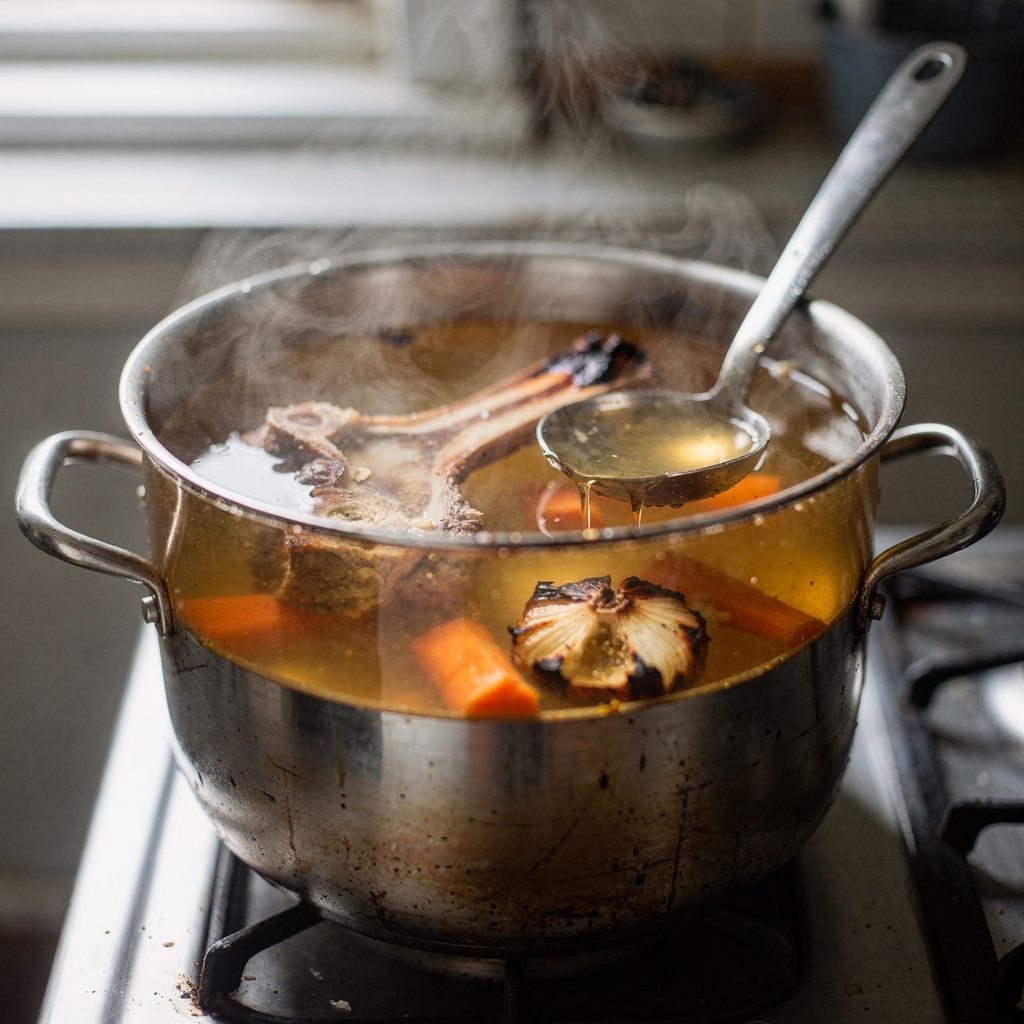
How to make beef stock clear: put the bones and meat into cold water, heat them slowly, skim off the foam for the first 15–20 minutes as the stock approaches a boil, then let it simmer gently below boiling point, around 90°C (195°F), for 4–6 hours. The key is never letting it boil hard. A rolling boil breaks fat and protein down into tiny particles that stay suspended in the stock as cloudiness. Below you'll find the ratios, timings, the reasons this works, and what to do if your stock clouds up anyway.
For roughly 2.5 L (10 cups) of finished stock, you'll need 2 kg (4.4 lb) of beef (half bones, half meat), 3.5 L (14.75 cups) of cold water, 400 g (14 oz) of root vegetables, and a few spices. Bones give the stock body and gelatin, while the meat brings flavor. Keep the ratio at roughly 1 kg (2.2 lb) of bones and meat per 1.5–2 L (6–8 cups) of water — add too much water and the stock turns out weak.
Bones (1 kg / 2.2 lb): marrow bones and, most importantly, oxtail, knuckle, or joint bones. Joints are richest in collagen, which breaks down into gelatin and makes the stock set once it cools.
Meat (1 kg / 2.2 lb): chuck, brisket, or short ribs. You want meat with connective tissue — lean cuts like sirloin won't give you much flavor here.
Vegetables (about 400 g / 14 oz): 2 carrots, 1 parsley root, a quarter of a celery root, and 1 onion, halved with the skin on and charred cut-side-down in a dry pan.
Spices: 10 black peppercorns, 5 allspice berries, 2 bay leaves, and optionally a small piece of nutmeg.
Salt: just 1 teaspoon at the start; season the rest once the stock is done.
In short: cold water → slow heating → skimming off the foam → 4–6 hours of gentle simmering at 85–95°C (185–205°F) → vegetables in for the last hour → straining. Here's the full method:
Rinse the bones and meat and place them in a large pot (at least 6 L / 6 quarts). Cover with 3.5 L (14.75 cups) of cold water.
Heat slowly over medium heat, about 30–40 minutes until the first bubbles appear. Heating slowly makes the proteins coagulate into large flakes you can easily skim off.
Skim off the foam with a slotted spoon or ladle. Most of it forms in the first 15–20 minutes as the stock approaches a boil.
Turn the heat down to the lowest setting. The surface should just tremble, with the occasional bubble breaking through — around 90°C (195°F). Leave the pot uncovered, or just prop the lid up a couple of centimeters.
Remove the meat once it's tender. Chuck needs 2.5–3 hours. Leave it in the whole time and it'll cook dry and stringy.
Add the vegetables and spices for the last 60–90 minutes. Cooking them longer breaks them down and clouds the stock while making it taste too sweet.
Simmer the bones for 4–6 hours total. Don't stir at any point.
Strain through a fine sieve lined with muslin or cheesecloth. Ladle the stock out rather than pouring the whole pot, sediment and all.
Season with salt only now, to taste.
Beef stock most often turns cloudy because it was boiled too hard. Vigorous bubbling breaks the fat into tiny droplets that emulsify into the water, and it also stirs up the coagulated proteins from the bottom of the pot. Both end up suspended in the stock as a milky haze that straining won't remove afterward. The stock stays clear as long as you keep the temperature between 85 and 95°C (185–205°F), ideally around 90°C (195°F).
Other culprits:
Starting with hot water. The proteins coagulate all at once into a fine haze instead of flakes that would float to the surface.
Stirring. This stirs up the sediment from the bottom.
A tightly fitted lid. The temperature can easily creep up to a full boil underneath it without you noticing.
Overcooked vegetables. Potatoes and other starchy vegetables have no place in a clear stock.
Straining in the dregs. Leave the last couple of deciliters in the pot.
You don't have to blanch the bones for beef stock, but blanching (boiling for 5 minutes, discarding the water, and rinsing the bones) helps if you want the clearest possible stock without spending ages skimming foam. Cover the bones with cold water, bring to a boil, boil for 5 minutes, discard the water, and rinse off the gray foam. Then start over with fresh cold water.
The trade-off: the stock turns out a touch milder and paler. If you skim the foam carefully as you go, you can skip blanching and lose less flavor.
Cook beef stock for 4–6 hours, just below a boil. Any shorter and you won't pull enough gelatin or flavor from the bones. After 8 hours, the flavor barely improves further, and the stock starts tasting overcooked, bony, and slightly bitter.
Quick meat stock (more meat, fewer bones): 2.5–3 hours.
Classic beef stock: 4–6 hours.
Rich bone stock for sauces and reductions: 6–8 hours.
Vegetables: only for the last 60–90 minutes, no matter how long the bones cook.
A noticeable amount of water evaporates over several hours. If the level drops below the bones, top it up with a little hot water so the temperature doesn't drop sharply.
Light stock is made from raw bones. For dark stock, you roast the bones first. Light stock suits soups with noodles or dumplings, where you want a clean, delicate flavor to shine through. Dark stock has a deeper, roasted flavor and amber color, making it the better base for sauces and reductions.
For dark stock, roast the bones on a baking sheet at 210–220°C (410–430°F) for 30–45 minutes, until golden brown — not blackened. Add the vegetables for the last 15 minutes. Deglaze the baking sheet with a little water and pour it into the pot — it's packed with flavor.
For a golden color in light stock too, an onion charred cut-side-down in a dry pan is enough. It adds color without overpowering the flavor.
The same rules apply to dark stock as to light: cold water, skim the foam, and never let it boil.
You can rescue a cloudy stock by straining it through muslin, and if that's not enough, clarify it with egg white. Start with the simplest method:
Let it cool and lift off the solidified fat from the surface — some of the haze will come off with it.
Strain it through muslin or a coffee filter. A fine sieve alone won't be enough.
Clarify it with egg white. The usual rule of thumb is about 2 egg whites per 1 L (4 cups). For 2 L (8 cups) of cooled stock, whisk 4 egg whites with a little water, stir them into the stock, and heat gently. Once it starts to warm up, stop stirring. The egg white will coagulate into a net that traps the haze as it rises, forming a gray crust on the surface. Let the stock simmer gently for 30–45 minutes — most of the haze will be caught in the first half hour. Then carefully poke a hole in the crust and strain the stock through muslin.
Clarifying costs you a bit of flavor. If the stock is going into a soup, steps 1 and 2 are usually enough.
Use beef stock as a base for soups, sauces, and risotto. Slice the cooked meat into the soup, or serve it on its own with horseradish and bread. The classic is beef broth with noodles, carrots, and chopped parsley, or with liver dumplings. For sauces that involve reducing the stock, go for a dark, unsalted stock, since reducing it will concentrate the salt too.
For how long stock keeps in the fridge and how to chill and freeze it safely, see the article Stock in the fridge: how long it lasts and how to store it.
Yes — a pressure cooker gets you beef stock in 1.5–2 hours instead of 5. Start by bringing it almost to a boil with the lid off and skimming the foam, then close the lid. Once it's done, let the pressure drop on its own; releasing the steam quickly will agitate the stock and cloud it.
Yes, and it usually comes out clear almost automatically, since a slow cooker never lets the stock boil hard. Even on LOW it'll creep close to boiling point after several hours, but without the vigorous boiling that causes cloudiness. Cook on LOW for 8–10 hours. Skim the foam on the stovetop at the start, or pre-blanch the bones, since skimming foam in a slow cooker is tricky.
Beef stock sets because gelatin has rendered out of the joints and connective tissue into the liquid — a sign of a good stock. It turns liquid again once reheated. If yours stays liquid after cooling, add more joint bones or oxtail next time, or cook it longer.
Season beef stock with salt only at the end, after straining. A lot of water evaporates over 4–6 hours, so stock salted at the start can end up too salty. If you're using it for a sauce you plan to reduce, leave it completely unsalted.
You can, but it stops being a pure beef stock and becomes a mixed one. A few chicken wings or necks will add gelatin and smoothness. Pork bones give a fattier, cloudier stock, while smoked bones will overpower the flavor. For a clear beef stock, stick to beef.
One recipe worth heating the oven for, one tip, and one deal from the shop. Nothing else.



