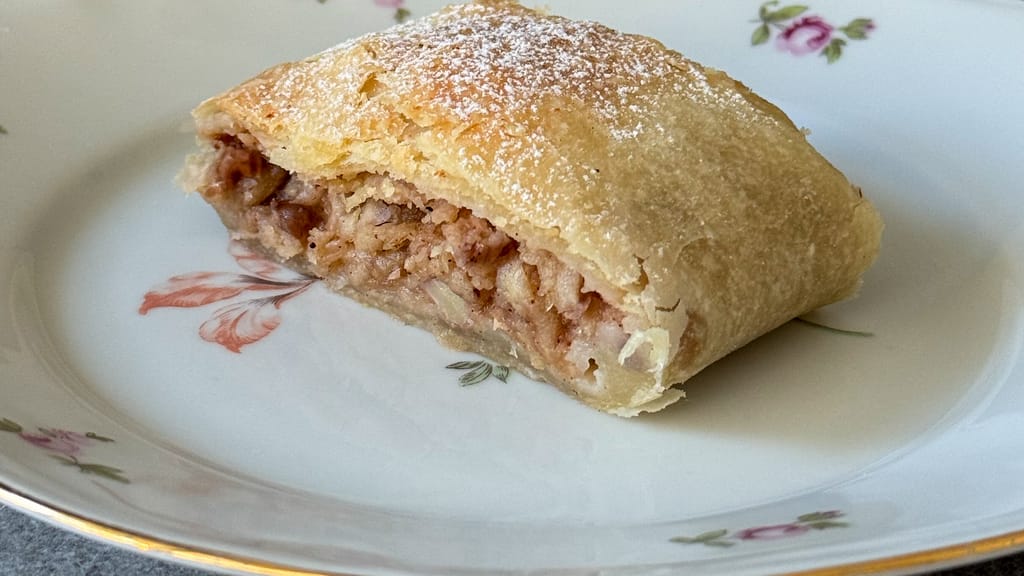
Apple strudel with homemade stretched pastry
Fruit Allergy: Symptoms, Cross-Reactions and What to Do About It

Updated Aug 30, 2026
Fruit allergy is most often a cross-reaction: your immune system recognises a protein from pollen and mistakes a similar protein in an apple, peach or kiwi for the same threat. That's why raw apple makes your palate itch, but the same apple baked into a strudel is fine — heat breaks that protein down. Most reactions stay confined to the mouth and fade within half an hour, but a smaller group of people react to proteins that survive cooking, and those can be dangerous. Below you'll find which fruits cross-react with what, what an allergy work-up actually involves, and how to adjust your kitchen so you don't have to give up fruit altogether. Only a doctor can give you a diagnosis — this article just helps you know what to ask.
Fruit allergy is an immune reaction in which the body mistakes a protein in fruit for a harmful invader and produces IgE antibodies against it. The next time you take a bite, the allergen binds to these antibodies, mast cells release histamine, and within minutes you feel itching, burning or swelling.
There are two distinct types, and the difference between them matters a lot:
Primary (Class 1)— the immune system became sensitised directly to the fruit. This is rarer, tends to start in childhood, and the proteins responsible are sturdy ones. The reaction can affect the whole body.
Secondary, cross-reactive (Class 2)— far more common in our part of the world. Pollen allergy comes first, and only later does the reaction to a similarly-shaped fruit protein appear. It typically shows up in the teens or adulthood, and symptoms usually stay confined to the mouth.
According to reviews of pollen-food allergy syndrome, four protein families are behind most cross-reactions: PR-10 (related to birch's Bet v 1), profilins, non-specific LTPs, and chitinases. Which one is yours determines whether you can have a bowl of stewed fruit — and how careful you need to be.
Allergy involves the immune system, intolerance doesn't — and that changes everything, from the level of risk to how big a 'safe' portion is.
Allergy:IgE antibodies, reaction within minutes, can affect the skin, breathing and circulation. Even a trace amount can trigger it.
Fructose intolerance:the small intestine can't absorb fructose fast enough, so it travels further down the gut and gets fermented by bacteria. The result is bloating, cramps and diarrhoea — hours after eating, never throat swelling. It's dose-dependent.
Sorbitol:a sugar alcohol found in pears, plums and other stone fruit. Same digestive symptoms, same dose-dependence.
Histamine intolerance:strawberries, citrus and tomatoes can release histamine even without antibodies being involved. Symptoms mimic allergy, but allergy tests come back negative.
If your stomach starts hurting three hours after eating fruit and your mouth never itches, it's probably not an allergy. But that call has to be made by a doctor, not by guessing at home.
Cross-reactions follow five main patterns — birch, mugwort, latex, profilins and LTP. Here they are, along with the fruits involved:
Birch (Bet v 1, PR-10 family):apple, pear, sweet cherry, sour cherry, peach, apricot, plum, kiwi, hazelnut, carrot, celery.
Mugwort (Art v 1 and other allergens):celery, carrot, fennel, aniseed, caraway and other spices from the carrot family.
Latex (hevein and chitinases):banana, avocado, kiwi, chestnut.
Profilins (Bet v 2 and related proteins):melon, watermelon, citrus fruit, tomato, banana.
LTP (Pru p 3 and related proteins):peach — mainly the skin — and other stone fruit, apple, nuts.
These lists come from published reviews on pollen-food syndromes; they don't mean you'll react to everything on a given line. The sections below explain what each pattern actually looks like in practice.
Bet v 1 from birch pollen and Mal d 1 from apple are structurally so alike that, according to published reviews, up to around 70% of people allergic to birch pollen report oral allergy symptoms after eating apple — though estimates range roughly between 40% and 75% depending on the population studied and how it's defined. In Central Europe, where birch is the dominant tree allergen, this is by far the most common scenario.
The good news: PR-10 proteins are fragile. They break down with heat and with stomach enzymes, which is why the reaction usually doesn't get past the mouth and throat. The bad news: during birch flowering season — roughly April here — symptoms tend to be stronger than in winter, because the body is already primed by the pollen.
Mugwort is behind the so-called celery–carrot–mugwort–spice syndrome. Around 95% of people allergic to mugwort have antibodies against its main allergen, Art v 1. This cross-reacts with celery's defensin protein, Api g 7, and is described in the literature as being associated with more severe reactions. Reactions to carrot, fennel, aniseed and caraway tend to be driven more by Bet v 1-like proteins (Api g 1, Dau c 1), profilins, and cross-reactive carbohydrate determinants.
The practical impact is trickier than with apple: celery and caraway aren't as easy to simply 'avoid by accident'. They turn up in stock, cured meats, root vegetable mixes for broth, and bread. At least celery is one of the fourteen allergens the EU requires to be labelled — unlike fruit.
Latex–fruit syndrome affects, according to an older review, 30–50% of people allergic to natural latex; more recent reviews report a much wider range depending on methodology and region, roughly 4–88%. The culprit is hevein and related chitinases — defence proteins found in both rubber trees and banana (Mus a 2) and avocado (Pers a 1).
If your hands itch from rubber gloves and you also react to banana, this is the most likely explanation. Mention it to your allergist explicitly — the latex-to-fruit connection is easy to miss, since people don't automatically link rubber gloves with lunch.
Profilins are pan-allergens — you'll find them in practically every plant, so reactions tend to be broad but mild. In a study of profilin sensitisation, people sensitised to Bet v 2 reported symptoms far more often than those sensitised only to Bet v 1: 67% vs. 0% for melon and watermelon, 66% vs. 8% for banana, 39% vs. 4% for citrus, and 33% vs. 0% for tomato.
Pepsin breaks down profilins in much the same way it breaks down PR-10 proteins, so the vast majority of people with a profilin allergy can tolerate the same food once it's cooked or otherwise processed.
Non-specific LTPs are the exception to every rule: they resist heat and acid, so cooking, baking and even stomach acid won't destroy them. The classic example is Pru p 3 from peach, described in the literature as a marker of risk for severe, whole-body reactions.
LTPs are most concentrated in the skin — in peach, far more than in the flesh. LTP allergy is typical of the Mediterranean but is also documented in Central Europe, and unlike pollen-cross-reactive allergies, it's usually described as permanent. Reactions are also often only triggered in combination with a cofactor: exercise, alcohol, ibuprofen, lack of sleep.
If you've felt unwell after fruit even when it was cooked, or if the reaction only hit after you went for a run following a meal, say so clearly to your allergist. That points toward LTP, and it changes the whole management plan.
The most common symptom of fruit allergy is itching and burning in the mouth within 5–15 minutes of the first bite of raw fruit — known medically as oral allergy syndrome. Here's the range, from mildest to most severe:
Mouth and throat:itchy tongue, palate and lips, tingling, a scratchy feeling in the throat.
Swelling:puffy lips, tongue or eyelids. Throat swelling is a warning sign in itself.
Skin:hives, redness around the mouth, worsening eczema in children. Sometimes just touching the fruit while peeling it is enough.
Digestive:cramping, nausea, vomiting, diarrhoea — with true allergy, typically within an hour.
Breathing and circulation:coughing, wheezing, breathlessness, dizziness, drop in blood pressure, confusion.
Timing is a useful clue. A cross-reaction hits immediately and usually resolves within 30–60 minutes. Symptoms that only appear hours later and are purely digestive point more toward intolerance. Either way, don't diagnose yourself — the symptoms overlap with reflux, mouth ulcers and infections.
Fruit allergy is diagnosed by an allergist using a combination of medical history, skin testing and blood tests for IgE — no single test is enough on its own, and a positive test without symptoms isn't a diagnosis. Here's what to expect:
Your medical history is the single most valuable part of a fruit allergy work-up: an allergist can often spot the pattern from it before any test confirms it. Expect to be asked:
What you ate, and whether it was raw or cooked.
How long after eating the reaction started, and how long it lasted.
What you did afterwards — exercise, alcohol, painkillers.
Whether you have hay fever, and which month it's worst.
Turning up with this already written down cuts the appointment time in half. A food-and-symptom diary kept for two to three weeks is often more informative than any single test.
In a classic skin prick test, a standardised extract is dropped on the forearm and the skin lightly pricked; a mosquito-bite-like bump appears within 15–20 minutes if positive. With fruit, though, there's a catch: PR-10 proteins and profilins are unstable in commercial extracts and break down, so the test can come back falsely negative.
The fix is a prick-to-prick test: the doctor pricks a fresh piece of the actual fruit with a needle, then immediately pricks your skin with the same needle. According to comparative studies, the sensitivity of prick-to-prick testing varies a lot by food — high for carrot and apple, notably lower for kiwi and tomato. So a negative result doesn't rule out an allergy; the history takes priority. If you're being tested because of apple, feel free to bring your own apple and ask if they'll use it.
A blood test for specific IgE shows sensitisation, but not whether you actually react in real life. Component-resolved diagnostics — which measure antibodies against specific proteins rather than the whole fruit — tend to be more useful.
The difference is entirely practical: high IgE against Mal d 1 points to a pollen-cross-reactive allergy with a mild course and a good chance you'll tolerate baked apple. High IgE against Pru p 3 points to LTP allergy and a completely different level of caution — cofactors included. You can't tell this from a simple 'I'm allergic to apple', and yet it determines how you should cook.
Removing the suspect food for two to four weeks and then reintroducing it under controlled conditions can help confirm the pattern — especially if you keep a diary throughout. The gold standard remains the supervised food challenge, but that has to be done at a facility equipped to handle an acute reaction.
Don't try this at home, especially not after a reaction that affected your breathing. And long 'just-in-case' elimination diets without professional guidance carry their own risk, since they needlessly narrow your diet.
Heat unfolds the 3D structure of PR-10 proteins and profilins, so IgE antibodies stop recognising them. What that means for you specifically is something your allergist should tell you. According to research on how cooking affects birch-related allergens, this holds true for IgE reactivity, but not necessarily for the T-cell response — so 'cooked equals completely risk-free' is an oversimplification.
Here's what common kitchen methods actually do to the protein:
Baking (180°C / 350°F, 30 minutes or more):reliably denatures both PR-10 proteins and profilins. Think strudel, pie, sponge cake.
Stewing and preserving (above 90°C / 194°F, 10 minutes or more):same effect, and it can be made ahead and jarred.
Microwaving (60–90 seconds):a quick way to 'tame' apple for porridge.
Drying — don't rely on it.Fruit is dried at low temperatures, so the proteins stay intact. Dried apricot can trigger the same reaction as fresh.
Freezing and blending:do nothing at all. A smoothie made from raw fruit is still raw fruit.
None of this destroys LTP.It's heat-stable — if your problem is Pru p 3, cooking won't protect you.
Two extra tips that help specifically with PR-10:
Peel it.Both LTP and part of the PR-10 protein sit in the skin.
Eat it fresh off the tree.Mal d 1 content in apples rises during storage, so a fridge apple from last spring is often worse than one picked in September.
Apple strudel with homemade stretched pastry
Apple strudel with homemade stretched pastry — the apples in the filling bake long and slow until fully soft.
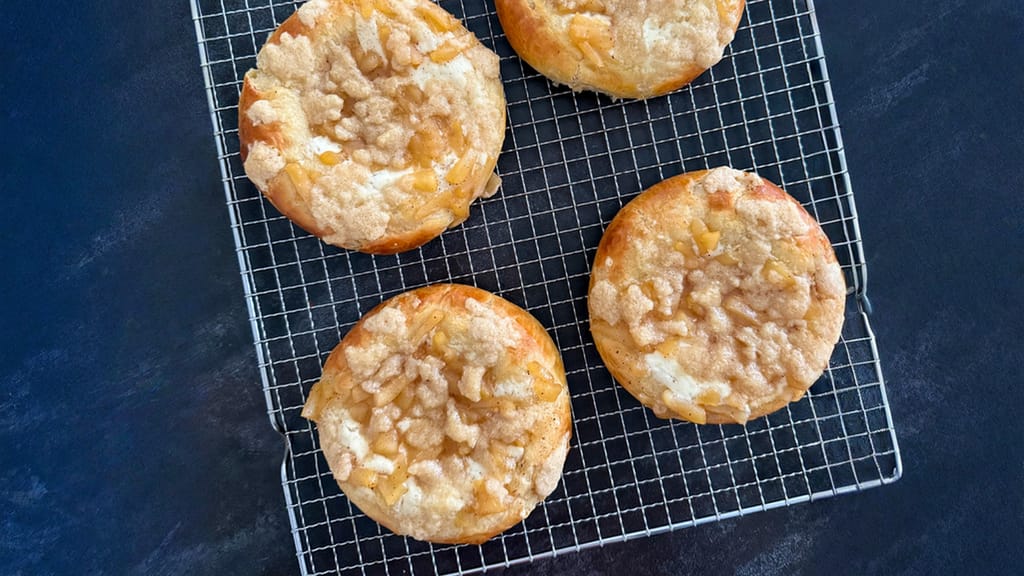
Yeasted apple buns with cottage cheese filling and crumble topping
Yeasted apple buns with curd cheese and crumble topping — another way to get apple into a fully cooked form.
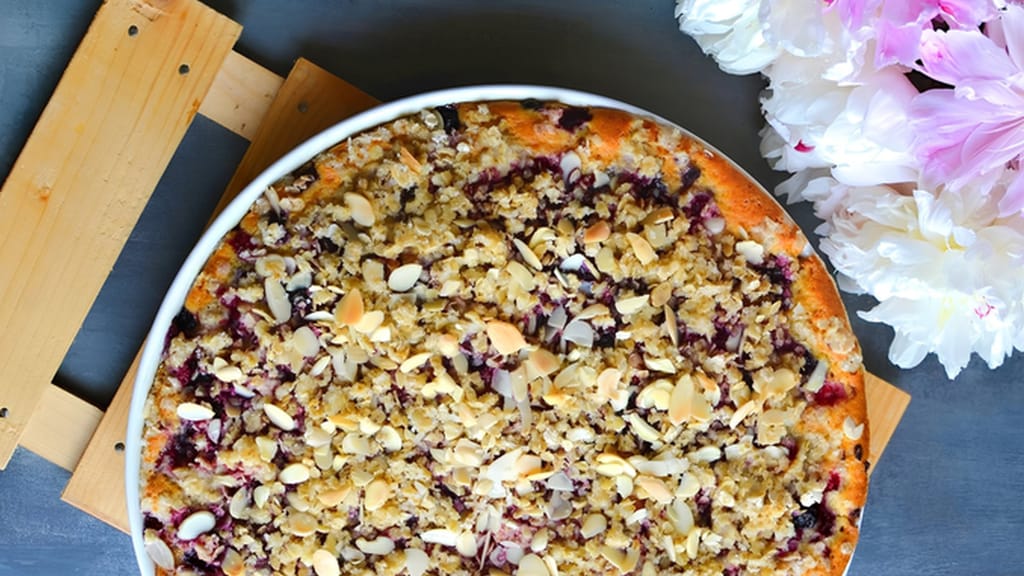
Bublanina with summer fruit and crunchy crumble
Summer fruit sponge cake with a crunchy crumble — apricots and peaches bake right into the batter.
When apple and stone fruit are off the table, the most reliable substitutes are berries outside the rose family, sweet vegetables, and cooked fruit. Specifically:
Blueberries, raspberries, blackberries, redcurrants.None of these belong to any of the main cross-reactive groups described above.Strawberries are the exception— they're part of the rose family, contain the PR-10 protein Fra a 1, and cross-react much like apple does. Older articles wrongly lump them in with 'safe berries'.
Pumpkin, carrot, sweet potato, courgette/zucchini.Baked, these add sweetness and moistness to a dessert. With carrot specifically, there's a documented difference between raw and cooked in the mugwort pattern — ask your allergist about it.
Dried fruit — only with caution.It has more fibre per portion and keeps longer, but drying doesn't remove the allergen.
Vitamin C from other sources.If kiwi and citrus are both off-limits, bell peppers, broccoli, sauerkraut, rosehip and sea buckthorn cover it — with no PR-10 and no latex-related chitinases.
One thing to watch: kiwi shows up on both lists in older reviews. It belongs to both the birch PR-10 pattern and the latex group, soit doesn't work as a 'safe' substitute— unless your allergist has told you otherwise.

Carrot cake with curd cheese frosting
Carrot cake with curd cheese — baked carrot as a sweet, fruit-free dessert base.

Pumpkin pie
Pumpkin pie — a fruit-free dessert for days when apple isn't on the menu.
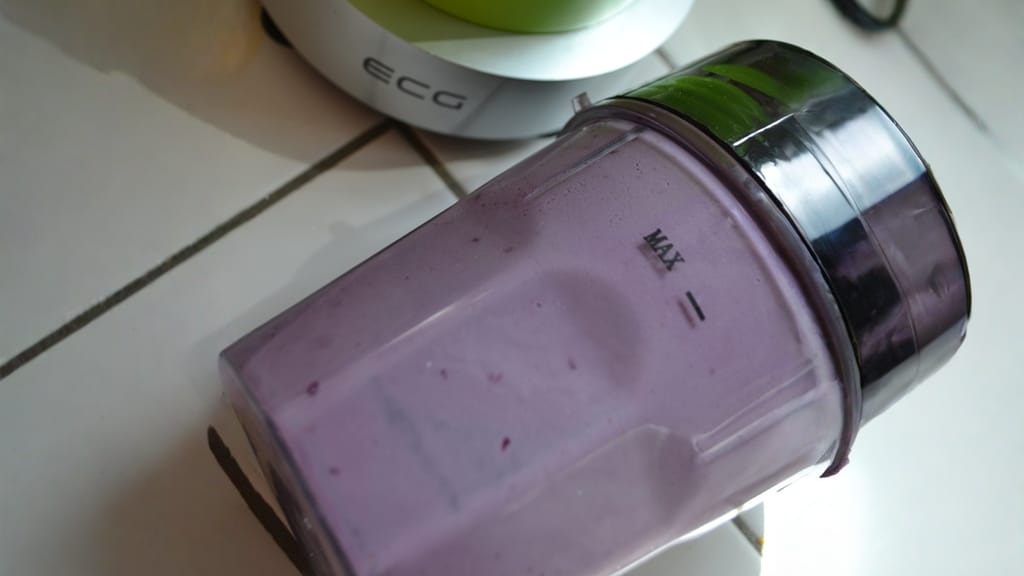
Mixed berry smoothie
Mixed berry smoothie — blueberries, raspberries and blackberries, served cold.
The riskiest spots aren't the obvious ones: fruit shows up in food as a filling, garnish, vinegar or sweetener — and you won't spot it on the label. The EU requires fourteen allergens to be declared (Regulation 1169/2011), including celery, mustard, lupin and sulphites, butno common fruit is on that list. You have to check the ingredients list yourself to catch apple hiding in a muesli bar.
What actually helps in practice:
Ask specific questions, not general ones.Saying 'I'm allergic to fruit' at a restaurant gets you nowhere. Asking 'Does this dressing have apple cider vinegar or lemon in it?' does.
Watch for hidden sources.Fruit purée used as a sweetener in yoghurts and snack bars, apple cider vinegar in dressings, lemon in stock, fruit teas, jam under a glaze, fillings inside pastries.
Cook fruit ahead of time.Keeping jarred stewed fruit or baked apple purée in the freezer means you always have a version on hand that you can tolerate.
Factor in the season.When birch is flowering, reactions tend to be stronger. Be more careful in April than in November.
Keep whatever your doctor prescribed on hand.Antihistamines for mild reactions, an adrenaline auto-injector if you've been prescribed one — and learn how to use it before you actually need to. What to take and when is for your doctor to decide, not an article.
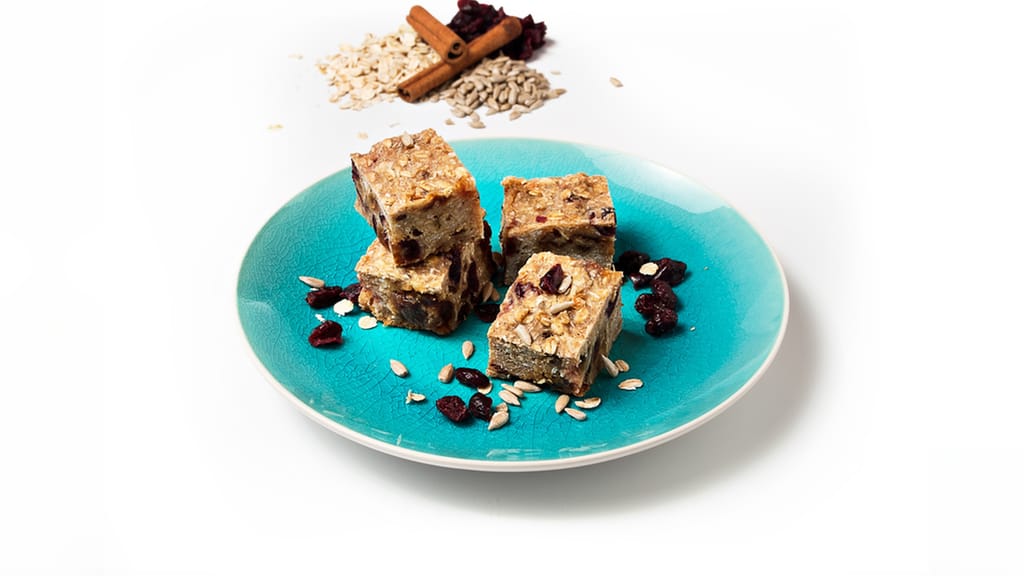
Oat bars with dried fruit
Oat squares with dried fruit — a grab-and-go snack; pick your own dried fruit based on what you tolerate.
Yes — fruit allergy commonly first appears in the teens or adulthood, because it's usually a cross-reaction to pollen. Secondary fruit allergy only develops once the body has become sensitised to pollen, so trouble with apples can start anywhere between your twenties and forties in someone who's eaten apples their whole life without issue. Primary fruit allergy, by contrast, tends to start in childhood.
According to review studies, roughly 2–5% of adults in Europe have a food allergy, with estimates running higher in children. In temperate climates, a large share of those adult cases are pollen-food cross-reactions to fruit and vegetables, since the pollen allergy typically develops first and the food reactions follow. Watch out for the difference between sensitisation (a positive test) and an actual allergy — confirmed cases are always significantly fewer than the number of people who report symptoms after eating.
Varieties low in the Mal d 1 allergen tend to be better tolerated — Santana performs best in studies. In one small study of 15 patients, 53% had no symptoms after eating Santana apples, a notably better result than with Golden Delicious or Topaz. Old heirloom varieties from extensive orchards also tend to have lower Mal d 1 levels, though not always. Whatever you try, do it in consultation with an allergist — not on your own.
Whether a fruit allergy fades depends on which protein is causing it: pollen-cross-reactive allergies (PR-10 proteins, profilins) can weaken over time, while LTP allergy tends to be permanent. Pollen-cross-reactive allergy also fluctuates with the season and can ease if the underlying pollen allergy is treated. LTP allergy (Pru p 3), on the other hand, is described in the literature as typically lifelong. Any changes should be monitored by an allergist — don't test it yourself by eating the food that made you sick again a year later.
Birch pollen immunotherapy sometimes eases apple reactions too, but it's not something you can rely on — it isn't an approved treatment for food allergy. Because Bet v 1 and Mal d 1 are structurally so similar, treating the pollen allergy can sometimes help with the fruit reaction as well; published pilot studies point in this direction, but results aren't consistent. The decision belongs to your allergist.
Oral allergy syndrome is rare in preschool children because it requires prior sensitisation to pollen, which builds up over years. In young children, a reaction to fruit is more likely to be a primary food allergy, contact irritation around the mouth from acidic fruit, or fructose intolerance. Telling these apart is a job for a paediatric allergist.
One recipe worth heating the oven for, one tip, and one deal from the shop. Nothing else.