- Season
- Year-round
- Price
- Low
Calories and nutrition
per 100 g
370 kcal
Calories
6.8 g
Protein
81.7 g
Carbs
0.6 g
Fat
Sticky Rice
Sticky rice (also called glutinous rice) is rice whose starch is almost entirely amylopectin, so it steams into a cohesive, chewy mass. Despite the name it contains no gluten; it is soaked for at least 4 hours before steaming.
per 100 g
370 kcal
Calories
6.8 g
Protein
81.7 g
Carbs
0.6 g
Fat
Keep uncooked sticky rice dry in a sealed container at room temperature and follow the best-before date. Keep cooked rice covered until serving so it doesn't dry out, but cool leftovers and get them into the fridge within an hour of cooking.
Cooked sticky rice keeps for 24 hours in a sealed container in the fridge, provided it went in within an hour of cooking. It hardens in the cold. Reheat it once by steaming, or in the microwave covered with a spoonful of water, until hot all the way through (at least 70 °C for 2 minutes).
Wrap cooled sticky rice in portions in plastic wrap and freezer bags and freeze it straight away. It keeps its best quality for about 3 months. Steam it from frozen until hot all the way through and soft again.
Look for glutinous rice, sweet rice or sticky rice on the label; Asian shops may also show the Thai name khao niao. Ordinary short-grain rice or jasmine rice won't give the same texture. The raw grains should be evenly opaque, milky white and whole, without yellowing or moisture. Black glutinous rice is a different product with a dark bran and takes longer to cook.
Sushi rice (short-grain japonica), soaked and steamed. It is sticky and chewy, but less cohesive than sticky rice.
Arborio rice, for savory dishes only. Its starch helps it hold together a little, but taste and texture differ.
Rinse the rice in cold water until the water runs almost clear, then soak it for at least 4 hours, ideally overnight. Drain it and spread it in a steamer basket lined with a damp cotton cloth or parchment. Steam over gently simmering water for about 25–30 minutes, turning it halfway. It is done when the grains are translucent, soft and still springy. Don't boil it in water; it turns to mush.
Press yesterday's leftover sticky rice into patties and pan-fry them until crisp, or steam it and serve with coconut milk and fruit. Use it by the next day at the latest and reheat it only once.
Roughly what a spoon or cup weighs, filled the way you usually would.
3.9 g
1 teaspoon
11.7 g
1 tablespoon
195 g
1 cup (250 ml)
Sticky rice is traditionally steamed, in a bamboo steamer or a woven Lao basket set over a pot. For desserts the hot rice is mixed with sweetened coconut milk, as in Thai mango sticky rice. In China it is wrapped in lotus leaves with meat and mushrooms, and in Japan mochigome is pounded into mochi. Cooked leftovers can be pan-fried into crisp patties. Don't boil it in water; you get a wet, gluey mass without the typical chew.
Sticky rice (Oryza sativa, glutinous varieties) is rice that, because of a mutation in the Waxy gene, contains almost no amylose; its starch is nearly all amylopectin. The raw grains are opaque and milky white; steamed, they turn translucent and bind into a springy, chewy mass. It is grown as long-grain varieties in Laos and Thailand and as short-grain varieties in Japan and China. Glutinous means glue-like: there is no gluten in it.
Sticky rice tastes mild, faintly sweet and neutral, so it works in savory and sweet dishes alike. Texture is the point: the grains are springy and chewy and hold together, but should never be wet or mushy. It soaks up coconut milk, sweet sauces and juices from grilled meat well.
Seasonal baking plans, tested recipes and kitchen tricks that save you time. Unsubscribe in one click.
3 min read
Sticky rice is a group of rice varieties whose starch is almost entirely amylopectin. Ordinary rice has 15–30 % amylose, which is why its grains separate after cooking. Sticky rice has almost none, so the grains bind together into a cohesive, chewy mass when steamed. It comes as long-grain (Thai and Lao khao niao), short-grain (Japanese mochigome, Chinese nuo mi) and black, with a dark bran.
Don't confuse sticky rice with sushi rice or jasmine rice. Sushi rice is short-grain japonica with a normal amylose content and is cooked in water; jasmine rice is a fragrant long-grain rice that only clings slightly once cooked. For how sushi rice is cooked, see sushi rice.
Rinse the rice and soak it in cold water for at least 4 hours, ideally overnight. Then drain it well and spread it in an even layer in a steamer basket lined with a damp cloth or perforated parchment. Steam it covered over gently simmering water for about 25–30 minutes, turning it halfway so it cooks evenly. It is done when every grain is translucent and none has a chalky white center.
A metal sieve or colander set over a pot and covered with a lid can stand in for a steamer basket. Just make sure the bottom of the sieve doesn't touch the water. Some rice cookers have a sticky rice setting; in that case follow the cooker's manual.
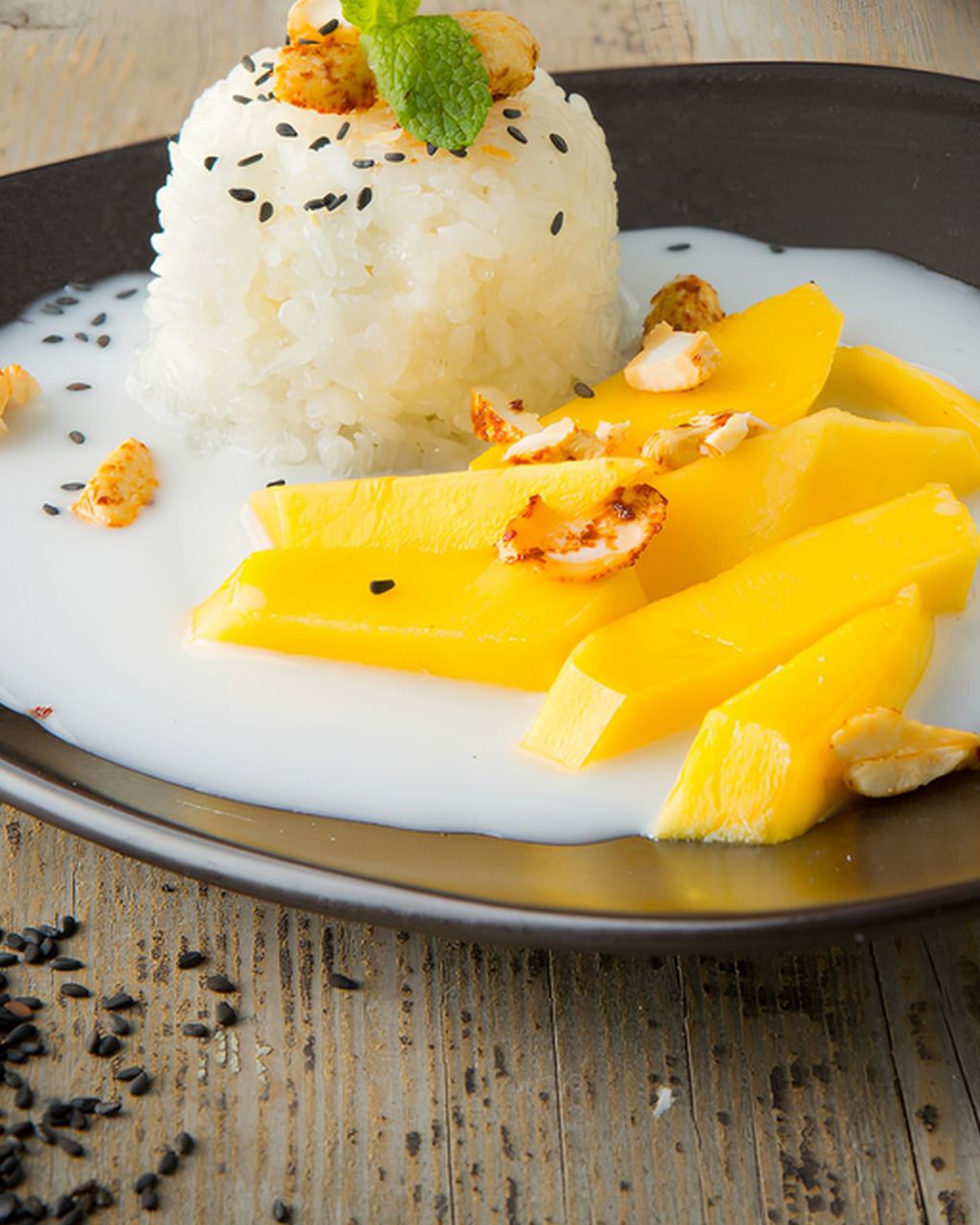
The best-known sweet sticky rice dish is Thai mango sticky rice: hot steamed rice is soaked in coconut milk warmed with sugar and salt, then served with ripe mango and another spoonful of salted coconut cream. Try mango sticky rice with salty cashews. In the savory cooking of Laos and northeast Thailand, sticky rice is eaten by hand, rolled into a ball, with grilled meat and spicy salads.
No. Sticky rice, like all rice, contains none of the gluten proteins of wheat, rye or barley. The word glutinous means glue-like and describes texture. People with coeliac disease should still check the label of ready-made products, since sauces, fillings and flour blends can contain gluten. Flour from sticky rice is also sold under the Japanese name mochiko and adds cohesion to gluten-free baking, as described in our gluten-free flour guide.
Sticky rice follows the same rules as any cooked rice. Bacillus cereus spores survive cooking, steaming included, and when rice cools slowly or sits at room temperature they produce a toxin that reheating does not destroy. Cool cooked rice and get it into the fridge within an hour, eat it within 24 hours and reheat it only once, until hot all the way through, at least 70 °C for 2 minutes. Don't leave sticky rice sitting in its basket on the table until evening.
Sticky rice hardens in the fridge but softens again with steam. For details on cooling, freezing and reheating rice, see how long cooked rice lasts in the fridge.
Sticky rice is most closely tied to mainland Southeast Asia. In Laos and Thailand's Isan region it is the everyday staple and is also given to monks on the morning alms round. Genetic studies show that the stickiness of all these varieties comes from the same mutation in the Waxy gene. In China sticky rice was used beyond the kitchen too: according to chemical analyses, a mortar of lime and sticky rice soup was used in city walls, tombs and sections of the Great Wall from the Ming dynasty.