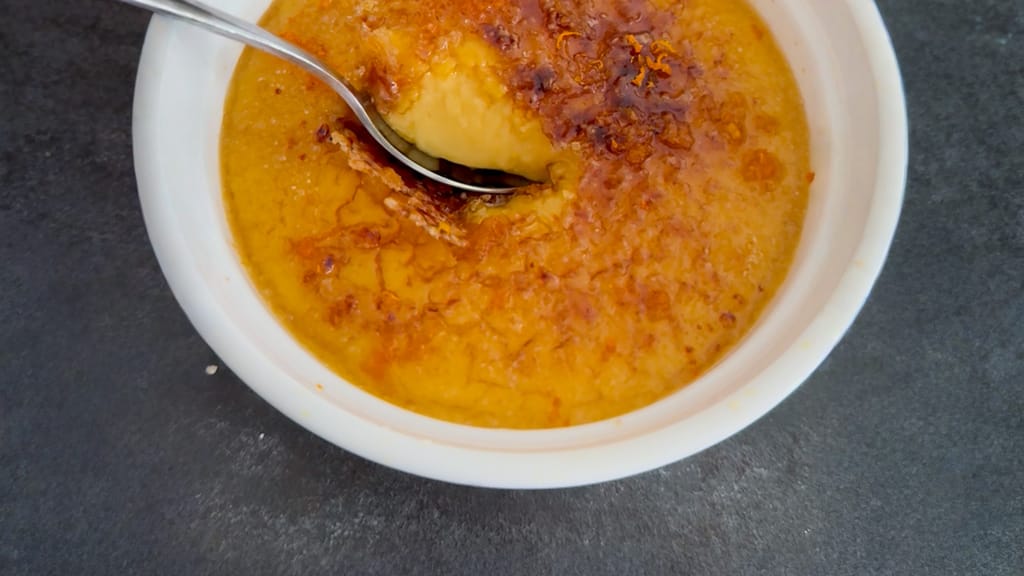
Crema catalana with orange zest and cinnamon
Updated Jul 19, 2026
Spanish desserts rest on three ingredients the peninsula inherited from the Moors and the Mediterranean: almonds, honey and eggs. From these came classics like churros dunked in thick hot chocolate, caramel-topped flan, crema catalana with its cracking sugar crust, and almond turrón. This article shows you how to make them — and, more importantly, what to pair them with so their flavour really shines.
Five desserts that define Spanish pastry-making:
Churros – fried choux-style dough dusted with sugar and cinnamon, dunked in thick hot chocolate.
Flan – a baked egg custard set with caramel, turned out onto a plate.
Crema catalana – a citrus- and cinnamon-scented custard with a crackling caramelised sugar crust.
Turrón – an almond and honey nougat, in both hard and soft versions.
Tarta de Santiago – a moist, flourless almond cake.
What unites them is a trio of ingredients rooted in Moorish and Mediterranean tradition: almonds, honey and eggs. Most of these sweets also carry a strong regional identity — turrón belongs to Alicante, crema catalana to Catalonia, and tarta de Santiago to Galicia.
Churros are fried strips of choux-style dough (flour, water, salt, fat) piped through a star-shaped nozzle straight into hot oil and fried until golden. Traditionally they're dusted with cinnamon sugar and dipped into thick hot chocolate — this pairing is the backbone of Spanish breakfasts and afternoon merienda alike.
The origin of churros isn't entirely clear-cut. Food historians trace them back to the Mediterranean tradition of fried dough known even to the Romans and Greeks, as well as to a Moorish sweet called zulabiya from the days of Al-Andalus. Regional versions vary: in Madrid, churros are thin and crisp, while in southern Spain you'll find the thicker, softer porras.
The key to success is oil temperature — around 180–190°C (350–375°F). If the oil's too cool, the dough soaks up fat and turns greasy; too hot, and the churros brown on the outside while staying raw inside. That star-shaped profile isn't just decorative — the ridges fry evenly and stop the dough from splitting as it cooks.
What to pair churros with:
Dark chocolate for the classic, intense dunking sauce.
Milk or white chocolate for a softer, sweeter profile.
A pinch of chilli or orange zest stirred into the chocolate for contrast.
Dulce de leche or caramel in place of chocolate.
You'll find the full method, plus the trick to a thick dipping sauce, in the guide to authentic churros and the perfect chocolate sauce. A dedicated churros recipe is coming soon on Yumsto.

Flan is a baked egg custard made from milk, eggs and sugar, cooked in a water bath over a layer of caramel and turned out onto a plate once chilled, so the caramel cascades down over the top. Its roots trace back to Roman egg custards, but the dessert as we know it today was shaped in Spain.
Traditional flan takes well to variations: swap part of the milk for coconut milk for a coconut flan, add orange zest for a fresh lift, or stir in melted chocolate for a chocolate version. A dedicated flan recipe is on its way for Yumsto; in the meantime, this detailed guide to smooth caramel flan will walk you through it.
The basics are simple: melt sugar in a pan until amber, pour the caramel into the bottom of the mould, then top it with a mixture of beaten eggs, milk and sugar, usually flavoured with vanilla. It bakes in a water bath at a low temperature, around 150–160°C (300–320°F).
The water bath is the crucial part — it keeps the heat gentle and even, so the custard stays silky and doesn't develop bubbles. Never let the mixture come to a boil, and just stir the eggs rather than whisking them, to avoid an airy, porous texture.
Flan is baked in the oven and threaded through with caramel, whereas crema catalana is cooked on the stovetop, thickened with starch, and only gets its crackling caramelised crust just before serving, when the sugar on top is torched. Crema catalana also carries a bolder citrus zest and cinnamon flavour and isn't turned out — it's eaten straight from the dish. A detailed comparison of the two custards is covered in the article on the differences between crema catalana and crème brûlée.
Crema catalana with orange zest and cinnamon
Crema catalana with orange zest and cinnamon — step by step
Turrón is a Spanish nougat made from almonds, honey and egg white, and it comes in two protected varieties: the hard turrón de Alicante, made with whole almonds, and the soft turrón de Jijona, made from ground almonds. Both carry the EU's Protected Geographical Indication (PGI) status and are produced around Jijona, in the province of Alicante.
The tradition dates back to Moorish rule, when almonds and honey first arrived on the peninsula; the earliest known mention of a local turrón comes from Valencia in 1484. Under PGI rules, turrón must contain a high proportion of almonds and at least 10% honey.

Turrón de Alicante (duro) is hard and crunchy — whole roasted almonds set in a honey-caramel mass. Turrón de Jijona (blando) is soft and creamy, since the almonds are ground into a fine paste. Both are built from the same ingredients, differing only in how the almonds are processed.
Turrón pairs according to its texture: hard turrón suits savoury, sharper flavours, while soft turrón pairs with fruit and coffee.
Hard turrón with dried fruit or a mature cheese like manchego — the sweetness plays beautifully against the saltiness.
Soft turrón with fresh pears, figs or a cup of espresso.
Grated turrón also works as an ice cream topping or folded into whipped cream.
An authentic turrón recipe is in the works for Yumsto; the technique for soft nougat is the same as in the homemade white nougat recipe below. The history and different types are covered in detail in the article on traditional Christmas turrón.
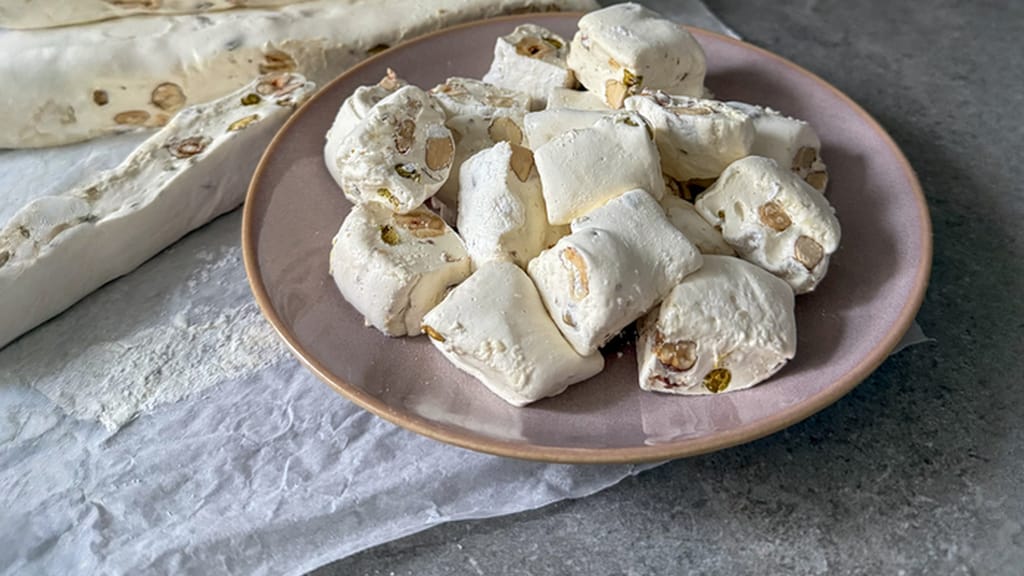
Montélimar nougat – homemade white nougat with honey and nuts
Homemade white nougat with honey and almonds — the closest relative of soft turrón de Jijona
Tarta de Santiago is a moist Galician cake made from ground almonds, sugar and eggs, flavoured with lemon or orange zest and a pinch of cinnamon. It contains no flour at all, making it naturally gluten-free. You'll recognise it by the Cross of Saint James stencilled onto the surface and dusted with icing sugar.
The cake holds Protected Geographical Indication (PGI) status: since 2006, only cakes made in Galicia with the required proportion of almonds may be sold under the name tarta de Santiago. A dedicated recipe is coming to Yumsto; in the meantime, this step-by-step guide to Santiago cake will walk you through it.
A cheat sheet for pairing, whenever you want the flavour to really shine:
Churros → thick hot chocolate, dulce de leche, a pinch of chilli or orange zest.
Flan → vanilla, orange zest, coconut milk, espresso.
Crema catalana → citrus zest, cinnamon, torched sugar on top.
Hard turrón → manchego, dried fruit, a glass of sweet wine.
Soft turrón → pears, figs, coffee.
Tarta de Santiago → lemon zest, almond liqueur, a spoonful of soured cream.
Churros are best fresh, within a couple of hours of frying. Keep them loosely covered at room temperature rather than sealed in an airtight box, where they'll turn soggy; a few minutes in a 180°C (350°F) oven will bring the crunch back. Skip the fridge altogether.
Bubbles and a curdled texture come from too much heat. Always bake flan in a water bath at 150–160°C (300–320°F), never let the mixture come to a boil, and simply stir the eggs rather than whisking them, so you don't beat in air.
Yes, but the result is different — an air fryer bakes churros rather than frying them, so they come out drier and less crispy than the oiled version. Brush the dough lightly with oil and cook at 190–200°C (375–400°F) until golden; it won't fully replicate that classic crisp fried crust, though.
Turrón is a traditional Christmas sweet, most popular from December through to Epiphany (Three Kings' Day). But it isn't limited to the holidays — paired with cheese, fruit or coffee, it works perfectly well all year round.
Tarta de Santiago (made from just ground almonds, sugar and eggs) is naturally gluten-free, as are classic flan, crema catalana and turrón. Churros, on the other hand, are made with wheat flour. Always check the label on store-bought versions.