Homemade caramel sauce with just 4 ingredients
Pudim Abade de Priscos: Portugal's Caramel Custard with a Secret of Bacon

Updated Jul 19, 2026
Pudim Abade de Priscos is a traditional Portuguese caramel custard from Braga, built on an unlikely trio: fifteen egg yolks, port wine, and bacon (or lard). It's that bacon that makes it one of the most unusual desserts in European cooking – you can't taste it in the finished pudding, but it gives the custard a silky softness and depth that yolks alone could never achieve. It was dreamed up in the 19th century by a parish priest, and it remains one of the crown jewels of Portuguese pastry to this day. In this article, you'll find out where it comes from, what goes into it and why, how to make it step by step, and how it differs from an ordinary caramel flan.
Pudim Abade de Priscos is a traditional Portuguese caramel custard made from egg yolks, sugar, port wine and bacon (or lard), baked in a water bath in a mould coated with liquid caramel. It hails from the parish of Priscos in northern Portugal, near Braga, and takes its name from its creator, the local parish priest.
Two things set it apart from an ordinary caramel flan (crème caramel): an unusually high number of yolks – classically fifteen – and a piece of bacon or lard mixed in. Together, they make the pudding denser, silkier and deeper in flavour than an everyday egg-and-milk custard. In 2011, it made the finalist shortlist in the Seven Wonders of Portuguese Gastronomy competition.
The Abade de Priscos was Father Manuel Joaquim Machado Rebelo – the parish priest (abade, meaning abbot or parish priest, not abbess) of Priscos in northern Portugal, near Braga. The recipe emerged in the second half of the 19th century out of his own culinary tinkering; Machado Rebelo was known as a passionate cook, and his pudding quickly built a reputation well beyond his own parish.
According to accounts from the time, he used whatever he had on hand – port wine from the nearby Douro valley, and pork lard or bacon from the country pantry. He himself is said to have remarked that "a pudding is easy to make, but hard to make well" – a line anyone who's ever chased the right consistency will recognise instantly.
Today, Pudim Abade de Priscos is a symbol of northern Portuguese pastry-making and a fixture on festive tables, from Christmas dinners to family celebrations.
A classic Pudim Abade de Priscos rests on six components: sugar for the caramel, fifteen egg yolks, water, port wine, a slice of bacon or a piece of lard (in Portuguese, toucinho) and aromatics – cinnamon and lemon zest. No cream, no milk, no vanilla; the softness comes entirely from the yolks and the fat.
In a recipe this simple, the quality of every ingredient shows immediately, so it's worth not cutting corners.
Fifteen yolks give the pudding its signature dense, almost creamy texture. The whites aren't used at all – they'd make the pudding rubbery and less delicate. Use the freshest eggs you can find; the freshness of the yolks has a direct effect on how firmly and smoothly the finished pudding sets.
Port wine gives the pudding its fruity depth and subtle spiced notes, the very thing that makes it unmistakably Portuguese. Tawny or vintage port is the traditional choice; a small glass, around 50 ml, is all you need. You'll notice the difference a good port makes the moment you taste it, so don't skimp by using cheap cooking wine.
Bacon or lard (toucinho) is the most unusual ingredient here – and also the most important – yet you'd never guess it's in there once the pudding is done. The fat melts into the hot sugar syrup, emulsifies with the yolks, and instead of adding any saltiness, it lends the pudding a supple texture, a beautiful sheen, and a barely perceptible smoky note in the background. It's exactly this sweet-savoury contrast that makes Pudim Abade de Priscos such a rarity among European desserts. Use good-quality, mildly smoked bacon, or pure pork lard.
Cinnamon and lemon zest perfume the syrup and balance out the richness of the yolks and fat. They're left to infuse in the hot syrup, which is then strained before being combined with the yolks, so no bits are left in the finished pudding. Use unwaxed, organic lemons – the zest's aroma comes through more strongly and without any bitterness.
Pudim Abade de Priscos comes together in four stages: coating the mould with caramel, infusing a sugar syrup with bacon, cinnamon and lemon, whisking the syrup and port into the egg yolks, and baking slowly in a water bath. Below, we'll walk through each step along with the most common mistakes – a complete, tested recipe with precise quantities is in the works as a separate piece.
The key to success is low and slow: high heat is the single most reliable way to ruin this pudding.
Start with the caramel: melt the sugar in a saucepan over medium heat until it turns a deep amber, then immediately pour it into the mould, swirling quickly to coat the sides. Stop as soon as it reaches amber – if it darkens further and starts to smoke, it will turn bitter and spoil the whole pudding. Work fast, as caramel sets within seconds.
Next, simmer sugar with water into a thin syrup and let the bacon, cinnamon and lemon zest infuse in it; only then stir in the port wine. Whisk the warm, strained syrup into the egg yolks in a thin stream – never hot, and never the other way around, or the yolks will curdle. Pass the finished mixture through a fine sieve so it comes out perfectly smooth. No cream or vanilla belongs in an authentic version – all the flavour comes from the syrup with its bacon and port.
Set the filled mould into a larger roasting tray and pour in hot water to about halfway up the sides of the mould. The water bath keeps the temperature gentle and even, so the pudding sets slowly and stays silky instead of curdling or puffing up. The water should be hot but never at a rolling boil – a gentle simmer is what you want.
Bake low and slow – around 150–160°C for roughly an hour, until the edges are set but the centre still has a slight wobble. Let it cool at room temperature, then chill in the fridge for at least two hours (overnight is even better) so it firms up enough to turn out cleanly. The three most common mistakes are: baking at too high a temperature (which cracks the pudding, causes bubbles and dries it out), letting the water bath boil hard, and pouring hot syrup straight onto the yolks.
Pudim Abade de Priscos is served chilled and turned out of its mould, so the caramel runs down the sides like a glossy glaze. It's rich enough on its own, so it's best paired with simple, contrasting accents rather than heavy sauces.
Seasonal fruit: raspberries or strawberries add colour and a tartness that cuts through the sweetness.
Fresh herbs: a sprig of mint or lemon balm for a fresh, citrusy contrast.
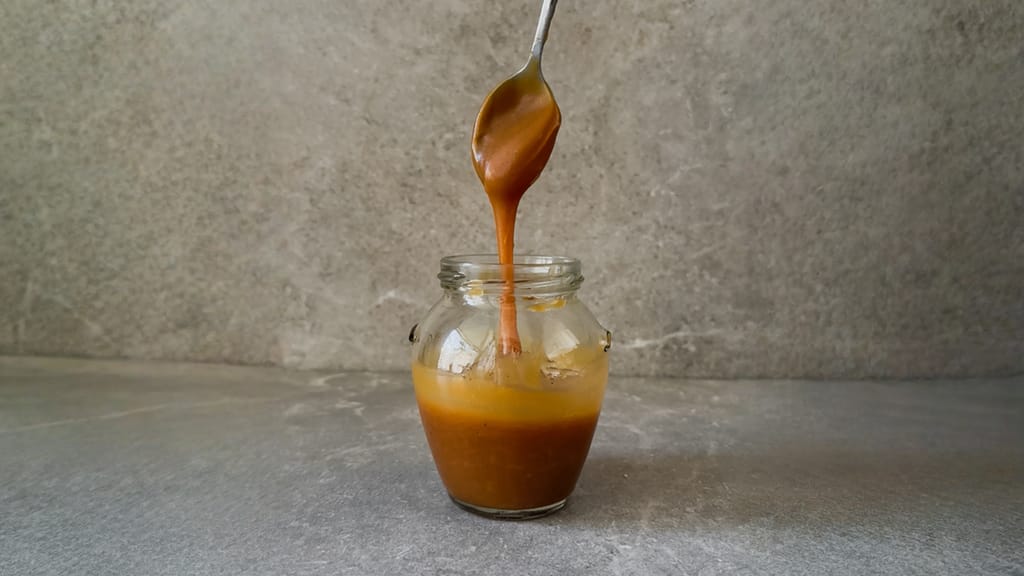
Extra caramel: a little extra homemade caramel sauce underlines the pudding's own caramel notes.
Texture: a few chopped, toasted nuts add crunch against the silky custard.
For a formal table, a simple white plate suits it best; for a casual gathering, serve a portion in a glass with fruit on top.
Homemade caramel sauce with just 4 ingredients
Homemade 4-ingredient caramel sauce – for pouring over the pudding
The core stays the same everywhere – yolks, caramel, port wine and fat – but variations do exist. In the north, where the pudding originates, versions stay closest to the original, with a strong port character and honest local ingredients.
In some families, the cook adds orange zest or extra cinnamon for a fresher, spicier aroma. In the warmer south, you'll find versions enriched with almonds or figs, which give the pudding a different texture. Younger Portuguese pastry chefs, meanwhile, like to experiment with the classic – you'll come across versions made with chocolate or lavender. Whichever one you try, the essence stays the same: a silky texture and a sweet-savoury depth you won't find anywhere else.
The closest match to port is a sweet fortified wine like madeira or a sweet sherry (Pedro Ximénez) – both offer a similar fruity depth. For an alcohol-free version, try grape must with a few drops of lemon; the flavour will be milder and less spiced, but the texture of the pudding will stay the same.
You can, but you'll lose exactly what makes this pudding special – its silkiness, its sheen, and the faint smoky note in the background. Without the fat, you'll end up with something closer to a plain caramel flan. And if you're skipping the bacon over concerns about flavour, there's no need to worry – you simply can't taste it in the finished dessert.
Some of the alcohol does remain, since the pudding is baked gently and only briefly, not long and hard. If you're serving children or non-drinkers, it's best to use an alcohol-free substitute for the port.
Covered in the fridge, it keeps for about 3 to 4 days, and the flavour actually deepens by the next day. Store it covered so it doesn't pick up fridge odours, and turn it out of the mould only just before serving. Freezing isn't recommended – the yolk-based structure turns watery once thawed.
Yes – in fact, a day ahead is ideal, since the pudding needs a good chilling in the fridge to firm up enough to turn out cleanly. Bake it in the evening, leave it in the fridge overnight, then simply unmould and serve the next day.
One recipe worth heating the oven for, one tip, and one deal from the shop. Nothing else.