Frozen Meat: How Long It Keeps and How to Thaw It Safely
How to Thaw Puff Pastry Quickly (Safely) and Stop It Cracking
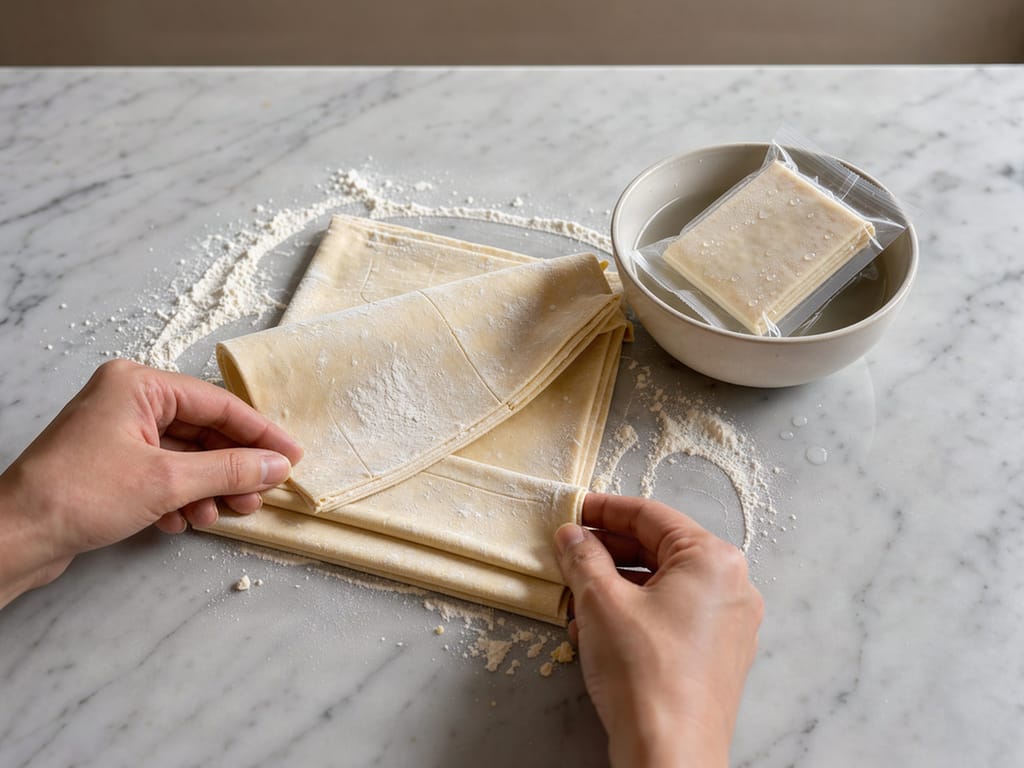
Updated Nov 21, 2026
The quickest safe way to thaw frozen puff pastry is in a sealed, leak-proof bag in cold water, changing the water every 30 minutes and baking it as soon as it is pliable, which follows the USDA's cold-water method. A short microwave thaw also works if your pack gives one, and the fridge thaw is the easiest of all. Whichever you use, keep the pastry cold so the butter layers stay intact and the sheets unfold without cracking.
The USDA's Food Safety and Inspection Service (FSIS) names three safe ways to thaw frozen food: in the refrigerator, in cold water, and in the microwave. All three work for puff pastry, at different speeds:
Cold water: the fastest method that keeps the pastry cold all the way through. Bake it as soon as it is thawed.
Microwave: fastest of all, but risky for the butter layers. Use only short bursts, and bake straight away.
Refrigerator: slowest, easiest and gentlest on the pastry. Best when you can plan ahead.
What doesn't work: hot water, a warm oven, or a sunny windowsill. Warmth melts the butter between the layers, and the pastry bakes flat and greasy instead of puffing.
This is our pick when you need puff pastry the same day; thin sheets thaw fastest.
Keep it sealed. Take the pastry out of its box and seal it in a zip-top bag with the air pressed out. Leave it in its original wrapping only if that wrapping is fully leak-proof. USDA FSIS asks for leak-proof packaging so that bacteria from the surroundings can't get in and the food doesn't soak up water, which would also make the dough soggy.
Submerge it in a bowl or sink of cold tap water. Weigh it down with a plate if it floats.
Change the water every 30 minutes, as USDA FSIS advises for cold-water thawing, so it stays cold.
Check it. Thin rolled sheets thaw much faster than a thick block. It is ready when it bends without resistance but still feels cold.
Bake it straight away. USDA FSIS advises cooking food thawed in cold water immediately.
Don't use warm water to speed things up. It softens the outside long before the middle thaws.
Use the microwave only if your package gives instructions for it, and follow them exactly. Pepperidge Farm, for example, says to wrap a sheet in a paper towel, microwave on HIGH for 15 seconds, turn it over and microwave for another 15 seconds; if it still won't unfold, add 5 seconds per side.
Microwaves vary a lot in power, so:
Start with less time than the pack says, not more.
Stop as soon as the sheet bends. Any patch of melted butter will bake up flat.
Bake straight away. USDA FSIS advises cooking food thawed in the microwave immediately, because parts of it can warm up during thawing.
Never microwave a whole frozen block; the edges melt while the middle stays frozen.
If you can plan ahead, this is the best method for the pastry and the simplest for you. Put the pastry in the refrigerator overnight, or for the time your pack gives (Pepperidge Farm sheets take about 4 hours, unwrapped and covered on a plate). Keep your fridge at 4 °C (40 °F) or below, the temperature USDA FSIS uses for refrigerator thawing.
The pastry stays cold the whole time, so the butter layers stay firm and distinct, and it rises best in the oven.
Some puff pastry is sold chilled as ready-rolled sheets and needs no thawing at all. Our guide to store-bought and homemade puff pastry covers the options.
Cracks almost always mean the pastry was unfolded too soon, while the folds were still frozen.
Wait until it bends easily. If you feel resistance at a fold, give it a few more minutes in the cold water or fridge.
Unfold gently, one fold at a time, without forcing it flat.
Repair cracks with water. Brush a little cold water along the crack, press the edges together and roll over it lightly with a rolling pin.
Roll lightly, in one direction at a time, on a lightly floured surface. Pressing hard squashes the layers.
Use a sharp knife or cutter and cut straight down; dragging seals the edges and they rise unevenly.
Over-thawed pastry turns soft and sticky and loses its layers in the oven. Pepperidge Farm's advice is to chill warm or sticky sheets promptly: about 5 minutes in the freezer or 10 to 15 minutes in the refrigerator.
Our habits for working with puff pastry:
Work with one sheet at a time and keep the rest in the fridge.
Chill shaped pastries in the fridge before baking if they have gone soft while you worked.
Bake in a fully preheated oven. The puff comes from a burst of steam, which needs strong heat from the start.
If your filling is wet, read our tips for filled puff pastry without a soggy bottom. You can also see what's in puff pastry on our ingredient page.
Recipe of the week, one tip that saves you time and one deal from the shop. Unsubscribe in one click.
The next issue goes out on Thursday, November 26.
USDA FSIS says food thawed in the refrigerator, and kept cold, can be refrozen with some loss of quality. Some manufacturers, including Pepperidge Farm, advise against refreezing their pastry, so check your pack. Pastry thawed in cold water or the microwave, or left out to warm up, should be baked, not refrozen raw.
For puff pastry the quality loss is real: ice crystals damage the layers, and refrozen pastry rises less. If you have thawed more than you need, bake the extra into something simple, such as cheese straws or palmiers, and freeze the baked pastry instead. For more on freezing safely, our guide to thawing frozen food safely explains the USDA methods in detail.
Seal it in a leak-proof bag and submerge it in cold water, changing the water every 30 minutes, as the USDA's cold-water method advises, then bake it straight away. Some packs also give a short microwave thaw; follow the pack's timing exactly.
Yes, briefly, if your pack allows it: Pepperidge Farm, for example, gives 15 seconds on high per side, wrapped in a paper towel. Go in short bursts, because melting the butter ruins the layers, and the USDA advises cooking food thawed in the microwave right away.
Thaw it in the fridge overnight, or for the time your pack gives: Pepperidge Farm says its sheets take about 4 hours, separated onto plates and covered with plastic wrap. The refrigerator is one of the USDA's three safe thawing methods. Fridge-thawed pastry stays cold and unfolds easily.
Puff pastry cracks along the folds when it is still partly frozen. Wait until it bends without resistance, then press any cracks together with a dab of water.
USDA FSIS says food thawed in the refrigerator, and kept cold, can be refrozen with some loss of quality, but some manufacturers, including Pepperidge Farm, advise against refreezing their pastry, so check your pack. Pastry thawed in cold water or the microwave, or left to warm up, should be baked, not refrozen raw.
One recipe worth heating the oven for, one tip, and one deal from the shop. Nothing else.