Smell Behind the Fridge: Causes, Cleaning and Prevention
How to Clean a Cooker Hood: Filters, Grease and Odours, Step by Step
Updated Jul 19, 2026
The easiest way to clean a cooker hood is to run the grease filter through the dishwasher every month or two, or soak it in hot water with washing-up liquid and baking soda, swap out the carbon filter after a few months instead of washing it, and wipe the outer surface according to its material. It sounds like a chore, but built-up grease saps the hood's suction power, keeps odours trapped in your kitchen, and is a fire hazard. Here's the full process, no fluff.
Cooker hoods use two types of filters, and each is maintained in a completely different way: the metal grease filter gets washed, the carbon filter doesn't get washed – it gets replaced. The classic advice to "soak the filters and wash them" only applies to the grease filter – water ruins a carbon cartridge.
Grease (metal) filter – an aluminium or stainless steel mesh that every cooker hood has. It traps grease from cooking vapours and can be washed by hand or in the dishwasher.
Carbon filter (activated charcoal) – absorbs odours. Only hoods running in recirculation mode have one. The standard type can't be regenerated – once it's saturated, you throw it out and fit a new one.
How do you tell which mode you have? If your hood vents air through ducting to the outside of your home (extraction mode), it doesn't need a carbon filter and you only need to look after the grease filter. If it filters the air and blows it back into the room (recirculation), it has a carbon cartridge inside that needs monitoring. Manufacturers also note that a carbon filter cuts a hood's suction by roughly a fifth, so it pays to replace it on time.
Recipe of the week, one tip that saves you time and one deal from the shop. Unsubscribe in one click.
The next issue goes out on Thursday, November 26.
Follow four different schedules depending on how often – and how greasily – you cook:
Grease filter: every 1–2 months, or as often as monthly if you fry daily. You can wash it more frequently in the dishwasher if you like.
Carbon filter: replace every 3–6 months (the standard cartridge can't be regenerated).
Motor and fan: check and clean once every 6–12 months, more often if you cook greasy food a lot.
Outer surface: a quick wipe-down once a week keeps grease from baking on.
These are just general guidelines – check your hood's manual for the exact interval and filter type for your model; some hoods even have a light that signals when the filter is saturated.
Clean the grease filter by soaking it in hot water with washing-up liquid and a tablespoon of baking soda for 15–20 minutes, then wiping it with a sponge and rinsing – or simply run it through the dishwasher on its own, on a lower cycle. Hot water does most of the grease-dissolving work for you, so scrubbing is kept to a minimum.
A sponge or soft cloth
Washing-up liquid or vinegar and baking soda
A sink or large bowl of hot water
An old toothbrush for the mesh grooves
Unplug the hood or switch it off at the fuse box.
Remove the grease filter – it's usually held in place by a latch or catch; press it and swing the mesh panel out.
Submerge it in hot (not boiling) water with washing-up liquid and 1–2 tablespoons of baking soda for 15–20 minutes.
Wipe it with a sponge, using an old toothbrush on any grimy grooves.
Rinse under running water and let it dry completely before refitting it – moisture inside the hood causes problems.

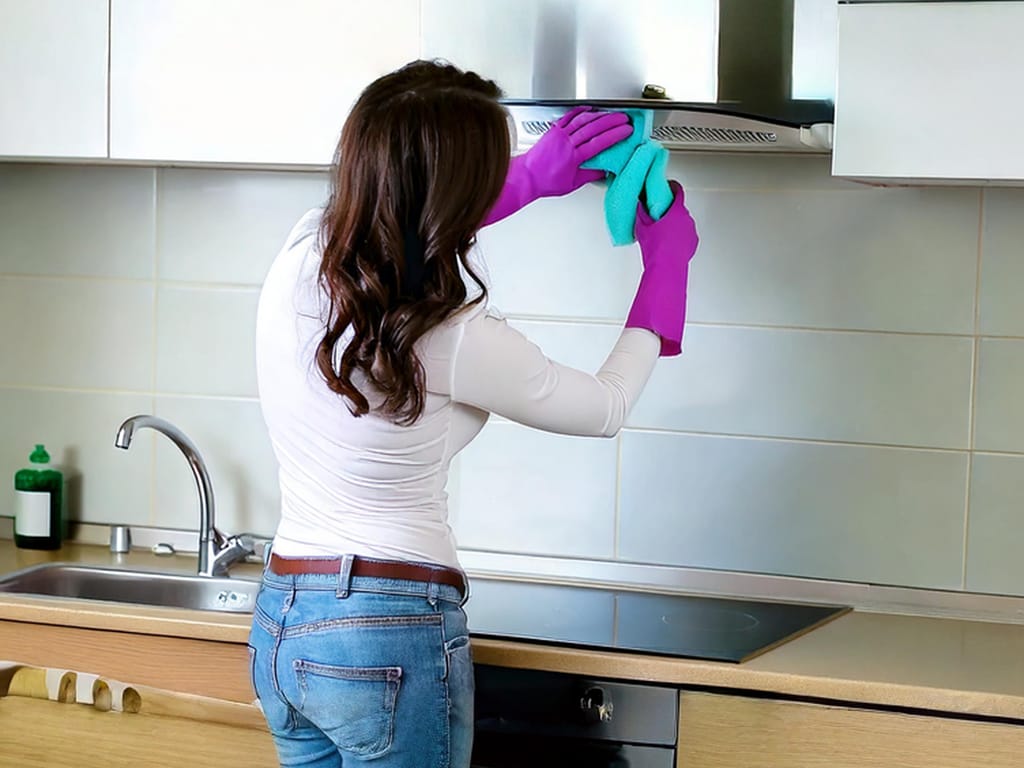
Clean the outer surface according to its material: stainless steel with a stainless steel cleaner, following the grain; glass with a 1:1 vinegar solution; and plastic with only a mild soapy solution. Using the wrong product can do more harm than good.
Always wipe stainless steel in the direction of the brushed grain, never in criss-cross motions – this avoids streaking. Use a cleaner made for stainless steel, which removes grease and leaves a thin protective film so fingerprints show up less. Apply it with a soft cloth and buff dry.
Glass parts respond well to a vinegar solution (1:1 water and vinegar) or an ordinary window spray. Spray it on, let it sit for a moment, then wipe completely dry with a soft cloth or paper towel – otherwise streaks form as it dries.
Plastic parts scratch easily, so stick to a mild soapy solution and a soft sponge. Avoid abrasive pastes, scouring pads, and harsh chemicals, which will permanently ruin the matte finish.
A smelly hood almost always means a clogged grease filter or an old carbon filter – tackle the cause first, then deal with the smell itself. If the filter is clean and the odour persists anyway, both home remedies and store-bought fresheners can help:
Lemon juice – mix the juice of one lemon with water, spray it onto the grease filter, let it sit, then rinse off. Lemon neutralises odours while also breaking down grease.
Baking soda – mixed with a little water into a paste, it absorbs sharp cooking smells; apply it to greasy spots and wipe off after 15 minutes.
Store-bought kitchen fresheners – choose ones without harsh solvents so they don't damage the hood's surface.
The same principle – find the source, don't just mask the smell – applies elsewhere in the kitchen too, like when you're dealing with odours coming from the back of your fridge.
The motor and fan only need cleaning once every six months to a year: unplug the hood, remove the filter and cover, wipe the fan blades and motor housing with a cloth dampened in a degreasing solution, and let everything dry fully before reassembling. Grease build-up on the blades reduces suction and puts unnecessary strain on the motor.
Before you reach inside, always unplug the hood first – this rules out any risk of electric shock. Wear gloves and ideally safety glasses too, since it's easy to cut yourself on sharp metal edges and fan blades, and you don't want cleaning solution splashing into your eyes. Reassemble everything exactly as per the manufacturer's instructions.
For most cooker hood maintenance, three cheap staples you probably already have at home will do the job:
Vinegar dissolves grease thanks to its acetic acid content. Mix it with water 1:1, spray it on the surface, and wipe off with a damp cloth after a few minutes. It also handles limescale well.
Lemon juice smells great and, thanks to its citric acid, has antibacterial properties. The juice of one lemon in half a litre of water makes a decent disinfecting spray for both countertops and the hood.
Baking soda gently scrubs away burnt-on residue without scratching surfaces. Mix it with water into a paste, apply, let it sit, then wipe off with a sponge.
Just go easy on both vinegar and baking soda with unlacquered aluminium – use a mild detergent there instead.
A clean cooker hood means better suction, a fresher kitchen, and a lower fire risk. The key is telling the two filters apart – wash the grease filter regularly, replace the carbon filter every few months – wipe the surface according to its material, and give the motor and fan a clean-out once a year. Hot water, washing-up liquid, vinegar and baking soda will cover most of the work.
Yes, you can put a metal grease filter in the dishwasher, but load it on its own, without other dishes, and pick a lower temperature setting. Unlacquered aluminium can turn dull or grey after a harsh detergent tablet, whereas stainless steel filters handle the dishwasher just fine.
Replace the carbon filter when odours linger in the kitchen even after cooking, the hood's suction weakens, or simply when 3–6 months have passed since the last swap. A standard carbon cartridge can't be washed or regenerated, so replacement is the only option.
No, a standard carbon filter can't be washed – water ruins the activated carbon, and the filter stops absorbing odours. The only exception is special "long-life" carbon filters, which can be rinsed and regenerated per the manufacturer's instructions, usually once every two to three years.
Dried-on grease responds best to a longer soak – leave the grease filter in hot water with washing-up liquid and baking soda, then wipe off the softened layer with a sponge. For stubborn spots, apply a thick baking soda paste, let it sit for 15 minutes, and only then scrub – save abrasive cleaners and scouring pads for materials that can handle scratches.
Weak suction is most often caused by a clogged grease filter or an old carbon filter, but a kinked or blocked ducting pipe, or the wrong fan setting, can also be to blame. Check both filters, replace the carbon cartridge if you have a recirculating hood, and make sure the air actually has somewhere to go.
One recipe worth heating the oven for, one tip, and one deal from the shop. Nothing else.