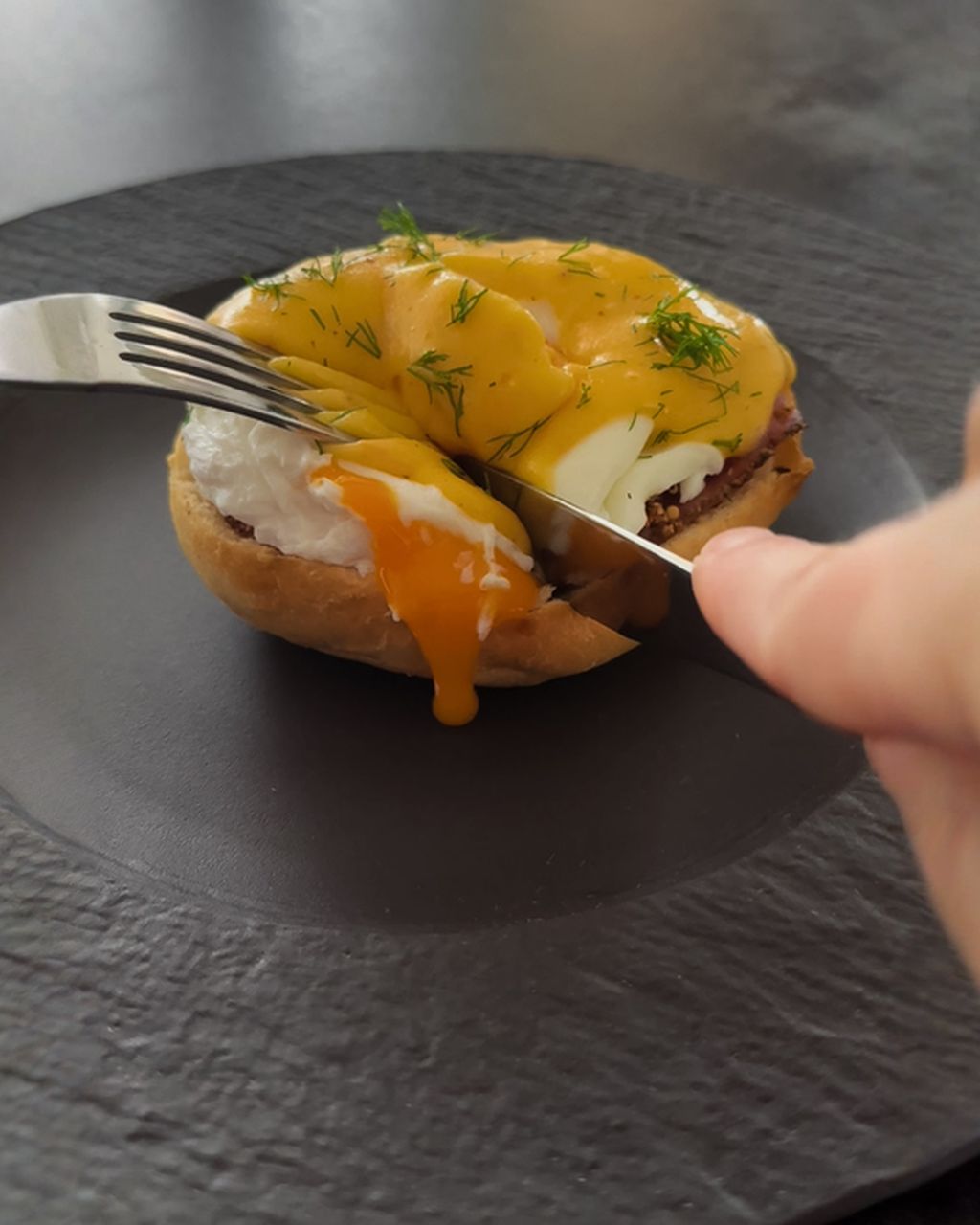
- Season
- Available all year; baked fresh every day and best eaten on the day it is baked
- Price
- Low
Calories and nutrition
per 100 g
319 kcal
Calories
9.8 g
Protein
55 g
Carbs
4.9 g
Fat
White bread roll
A houska is the round Czech everyday bread roll made from wheat flour, water, yeast and salt, braided into a knot or stamped, with a crisp crust and a soft crumb. It usually weighs 50 g and is made from the same dough as a rohlík; only the shape differs.
per 100 g
319 kcal
Calories
9.8 g
Protein
55 g
Carbs
4.9 g
Fat
Keep in a paper bag or bread bin at room temperature and eat the same day, the next day at the latest. In plastic the crust goes soft within hours. Dry rolls still work for croutons, dumplings or breadcrumbs.
Not recommended: bread rolls go stale faster in the fridge than on the counter.
Freeze on the day you buy them in a well-sealed freezer bag; they keep their quality for about 3 months. Let them soften on the counter for 30–60 minutes, then warm for 5 minutes in an oven preheated to 180–200 °C so the crust crisps again.
Buy rolls on the day they are baked; most bakeries and supermarkets put out fresh ones in the morning and often again during the day. A good houska feels light for its size, has an even golden-brown crust that crackles when gently squeezed, and a clear braid or stamp. Avoid soft, rubbery rolls (they are older or have been in plastic) and pale or flat ones. Packaged rolls and shop websites list ingredients and allergens: a plain houska is usually wheat flour, water, yeast, salt and a little rapeseed oil, often with sugar, barley malt flour or a baking improver. If you avoid sesame, milk or egg, look for "may contain" warnings.
A Czech rohlík: it is made from the same dough and differs only in shape, so it works in every cold and cooked use.
Any small crusty white wheat roll, such as a kaiser roll or a piece of white baguette or veka. Expect a slightly different crust-to-crumb ratio.
A houska is usually split horizontally, buttered and topped with ham, cheese or a spread, or served with soup, goulash or sausages. Revive a day-old roll by sprinkling it with water and baking it for 3–5 minutes in an oven preheated to 180–200 °C. Cut dry rolls into cubes for croutons and bread dumplings, or grate them into breadcrumbs.
Stale rolls are a staple ingredient in Czech cooking. Grate fully dried ones into breadcrumbs for coating schnitzels and fried cheese. Cut them into croutons for soup or cubes for bread dumplings (houskový knedlík), or soak them for žemlovka and stuffing.
Roughly what one piece weighs.
50 g
1 piece
A houska is a finished bread, eaten mostly fresh, filled, or alongside soup, goulash and sausages. Day-old rolls get a second life in the kitchen: toasted into croutons, soaked and baked in žemlovka and stuffing, cubed into bread dumplings, or dried and grated into breadcrumbs. Bakers make it from a simple yeasted dough, shaped into balls, braided or stamped, proved, and baked in a hot oven with steam for a thin, crisp crust.
A houska is the round Czech everyday bread roll made from wheat flour, water, yeast and salt, braided into a knot or stamped, with a crisp crust and a soft crumb. Czech bakeries and supermarkets sell it loose by the piece, and it usually weighs 50 g. It is made from the same dough as a rohlík; only the shape differs. The dough is shaped into a ball and then either tied into a low knot (pletená houska, braided roll) or pressed with a stamp that leaves a radiating pattern on top (ražená houska, stamped roll). Before baking it is often topped with poppy seeds, caraway, salt or sesame. Under Czech Decree 18/2020, a houska is běžné pečivo (everyday rolls): less than 8% fat and less than 5% sugar, counted against the weight of flour used.
A mild, clean wheat taste, a lightly salty crust with a toasted flavour and a neutral, airy crumb. Poppy seeds add a gentle nutty note, caraway a warm aroma. A fresh houska crackles under your fingers. By the next day the crust softens and the crumb dries out, which is why Czechs buy rolls every day.
Seasonal baking plans, tested recipes and kitchen tricks that save you time. Unsubscribe in one click.
4 min read
A standard houska from a Czech bakery or supermarket weighs 50 g; that is what Czech bakeries list for their stamped rolls in online shops. Speciality rolls are heavier: cereal rolls about 60 g, filled or "gourmet" rolls 70 g or more.
Under Czech Decree 18/2020, a single baked item up to 150 g may weigh at most 10% less than the stated weight, so a roll sold as 50 g can weigh 45 g. If a recipe needs an exact amount, for example for dumplings, weigh the rolls.
The classic shape: a strand of dough tied or braided into a low round knot, often with poppy seeds or caraway.
A ball of dough pressed with a stamp that leaves a radiating pattern on top. Its shape resembles the Austrian kaiser roll. Bakeries sell it with or without a topping.
Plain, poppy seed, caraway, salt, sesame or mixed seeds. The dough is always the same.
Bakeries also sell wholegrain, multigrain and cereal rolls, and rolls filled or baked with cheese or ham. They are different products from the plain white houska and are sold under their own names. A wholegrain roll must contain at least 80% wholegrain flour.
A houska and a rohlík are made from the same lean wheat dough. The houska is round, braided or stamped; the rohlík is rolled into a long, sometimes curved shape. They taste the same and are used the same way; a houska simply has more crumb per piece.
A kaiser roll (kaiserka) is the Austrian type of roll (Kaisersemmel) with a five-part star, traditionally made with barley malt in the dough. Veka is a long loaf of similar dough, sliced for open sandwiches (chlebíčky) and toast.
The Czech decree on bakery products sets three main types of pečivo. Běžné pečivo (everyday rolls) has less than 8% fat and less than 5% sugar; housky, rohlíky, kaiser rolls and veka belong here. Jemné pečivo (fine or enriched baked goods) has at least 8% fat or at least 5% sugar, and is often filled or surface-finished, such as loupák, vánočka or koláč. Fat and sugar are counted against the weight of flour used, not the whole product. Trvanlivé pečivo (long-life baked goods) has at most 10% water, or 16% for perník and pretzels.
Běžné pečivo is further divided into wheat, rye, rye-wheat, wheat-rye, wholegrain, graham, multigrain and speciality. The white houska is wheat běžné pečivo. Under EU Regulation 1169/2011, allergens must be shown on packaged food and be available for loose food too.
A houska is best on the day it is baked. In a paper bag it keeps until the next day; in the fridge it goes stale faster. Freeze what you will not eat on the day you buy it, in a sealed bag, and warm the rolls briefly in a hot oven before eating.
How to thaw rolls and bread so they are as crusty as fresh is covered in how to thaw bread and rolls.
Czech cooks have always cooked with hard rolls. Grate fully dry ones into breadcrumbs, toast cubes into croutons, or add them to bread dumplings and stuffing. Soaked in milk and egg, they become žemlovka.
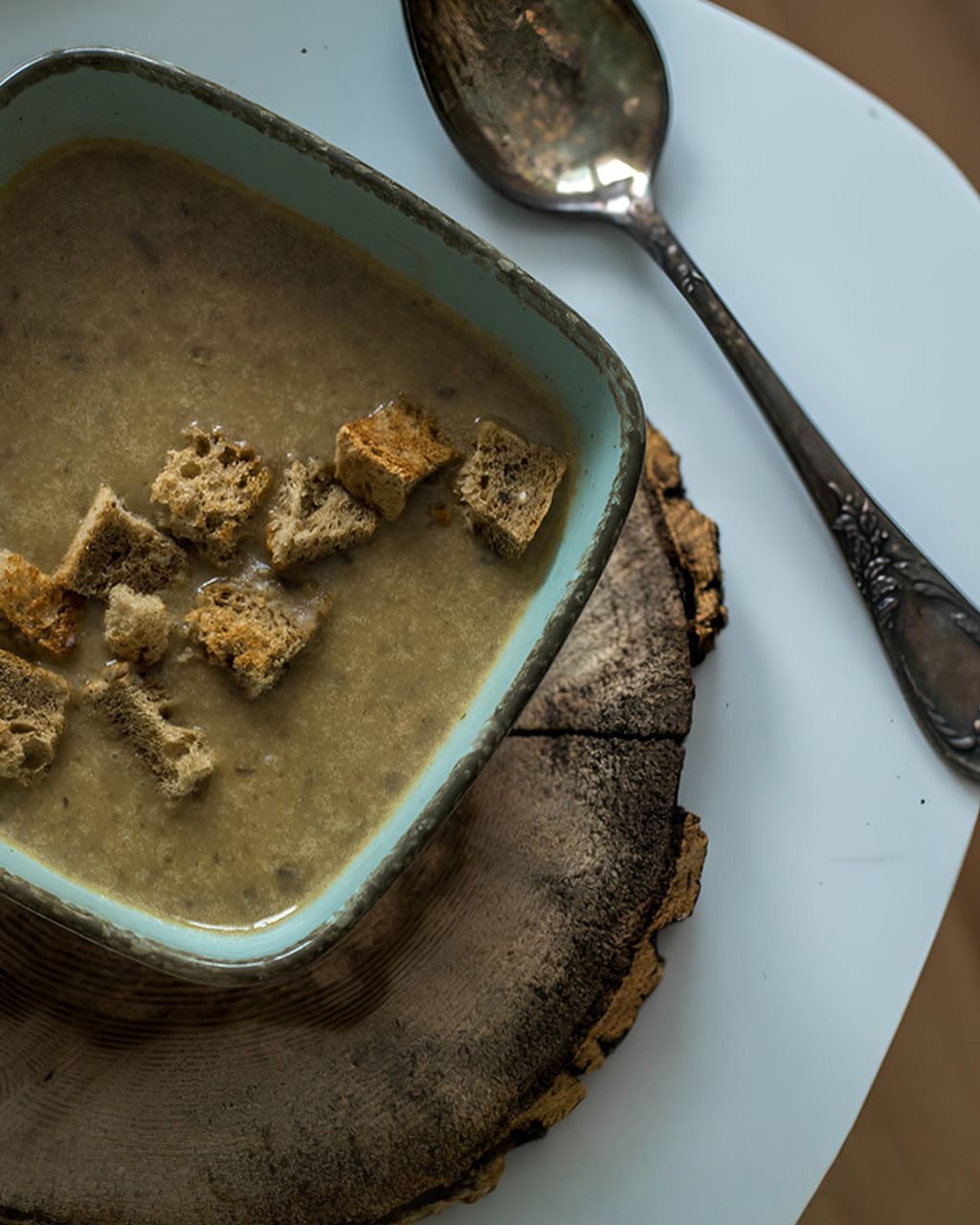
Toasted cubes of houska make a crunchy finish for mushroom soup. A žemlovka recipe is in what to do with stale vánočka, and how to freeze cooked bread dumplings is in how to freeze dumplings.
The houska is one of the traditional shapes of Czech everyday bread and, alongside the rohlík, is still baked daily across the country. Its name lives on in the kitchen too, in houskový knedlík (bread dumpling).
A houska is a simple yeasted dough of wheat flour (usually fine white), water, yeast and salt. Kneading builds a gluten network that traps gas from the yeast, which makes the crumb light and airy. Baking at a high temperature with steam keeps the surface moist at first, so the roll can rise fully and form a thin, glossy crust. As the crust browns, the Maillard reaction gives it its toasted flavour. Going stale is mainly starch retrogradation: as the roll cools, the starch slowly recrystallises and the crumb firms. This happens fastest at fridge temperature, so keep rolls at room temperature or freeze them.