Light and airy génoise sponge cake
Pão de Ló: Traditional Portuguese Sponge Cake, Step by Step

Updated Jul 19, 2026
Pão de Ló is a traditional Portuguese sponge cake made from just three ingredients – eggs, sugar and flour – baked without any baking powder or yeast. Its volume comes purely from air whipped into the eggs, which is exactly why it turns out so light and delicate that it practically melts in your mouth. The recipe traces back to Portuguese convents as early as the 18th century, and it's still baked today in many regional versions – from fully baked through to deliberately custardy and gooey. Here's how to make it at home: what you'll need, how to handle the batter, and where most people go wrong.
Pão de Ló is a Portuguese sponge cake made from just three basic ingredients – eggs, sugar and flour – with no baking powder or yeast. Its lightness doesn't come from chemistry but from mechanics: long whisking works air into the eggs, which then expands in the oven's heat and lifts the batter.
Historians trace the recipe back to Portuguese convents by at least the 18th century, often linking it to the Santa Maria de Cós monastery. Nuns baked these desserts for religious feast days, and once the convents were dissolved in the 19th century, the recipes spread among the local population.
Portuguese sailors carried the sponge cake as far as Japan, where it evolved into the still-popular castella (kasutera) – its name nods to the older Portuguese term pão de Castela.
A classic Pão de Ló comes together from 6 eggs, 200g of sugar and 150g of plain flour, baked for around 30 minutes in an oven heated to 180°C. The real trick lies in whisking the eggs into a thick foam and then folding in the flour gently, so the batter doesn't lose its air.
6 large eggs (room temperature)
200g granulated sugar
150g plain flour
a pinch of salt
zest of ½ organic lemon (optional)
a round cake tin, 24cm in diameter
Preheat the oven to 180°C and line the tin with baking paper.
Whisk the eggs, sugar and a pinch of salt with a hand whisk or stand mixer for 8–10 minutes, until you get a pale, airy foam that has tripled in volume and falls from the whisk in a continuous "ribbon".
Fold in the lemon zest. Sift the flour and add it in stages, folding it in with a spatula using gentle circular strokes from the bottom up – as few strokes as possible, so the foam doesn't deflate.
Pour the batter into the tin and just lightly smooth the surface.
Bake for 25–30 minutes. A fully baked sponge will be golden, with a skewer inserted into the centre coming out clean. For a creamier, barely-set centre in the Ovar style, cut the baking time to 18–22 minutes, so the skewer still comes out a little moist.
Let it rest in the tin for a few minutes, then turn it out onto a wire rack. Serve simply dusted with sugar.

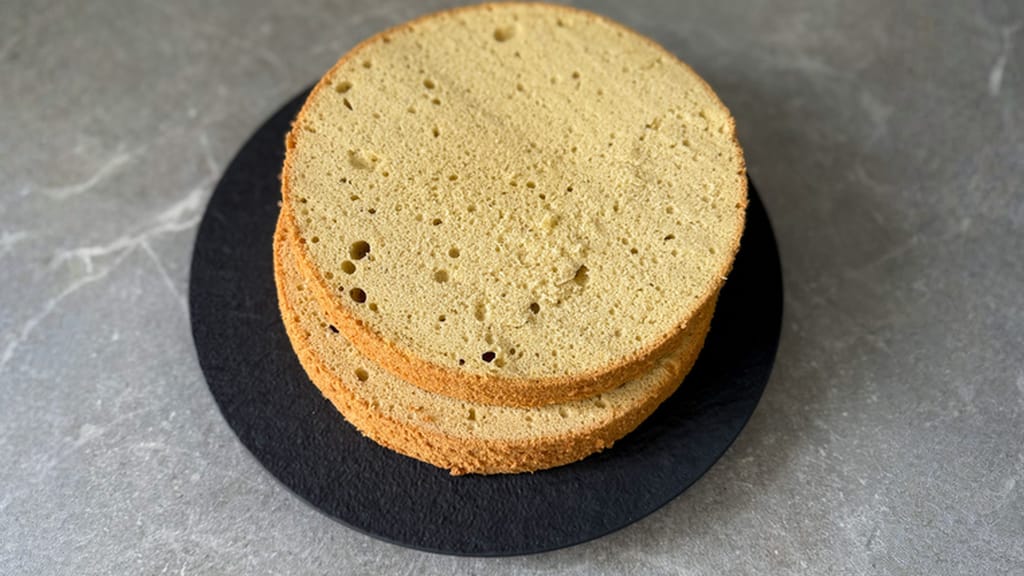
Light and airy génoise sponge cake
The airy crumb of a Génoise sponge – another cake that relies purely on whipped air, with no raising agent
Pão de Ló doesn't need baking powder or yeast because it's lifted purely by the air whisked into the eggs. Long whisking creates a stable foam full of tiny bubbles; in the oven's heat, water vapour inside those bubbles expands and increases the volume, while the egg protein sets and locks the structure in place.
That's why it's so important to whisk the eggs thoroughly and then fold in the flour as gently as possible. Every unnecessary stroke breaks down the bubbles – and the lightness disappears along with them. Egg yolks also give the sponge its colour, moistness and characteristic flavour, which is why traditional versions tend to be rich in yolks.
Three things most often trip up a Pão de Ló: under-whipped eggs, folding the flour in too roughly, and getting the oven wrong. Keep an eye on these three and you won't need to worry about the result.
Under-whipped eggs – the foam needs to triple in volume and fall in a continuous ribbon. Under-whipped eggs mean a flat, dense sponge.
Overmixing once the flour goes in – once you start adding flour, switch to a spatula and mix only until just combined. A whisk or mixer at this stage will beat the air right back out of the batter.
Opening the oven door – keep the door closed for the first 20 minutes and check through the glass instead. A sudden temperature drop will cause the centre to sink.
Eyeballing the measurements – use kitchen scales, not cups. Even a small deviation in the ratio of eggs, sugar and flour makes a difference.
The three best-known Portuguese versions differ mainly in how far they're baked and in shape: Ovar has a custardy, barely-set centre, Alfeizerão is moist and flavoured with aguardente brandy, and Felgueiras (castela from Margaride) is pale, delicate and richer in egg yolks. Each region turns the same basic recipe into a completely different dessert.
The Ovar version is baked briefly at a lower temperature, so the centre stays custardy and almost liquid – the Portuguese call it "pito". It's traditionally baked in paper-lined terracotta dishes, and since 2016 it has held protected geographical status.
Alfeizerão is famous for its moist, underbaked centre. Legend has it the cake was accidentally served underbaked to King Carlos I, who loved it anyway – and the "mistake" became the recipe. Aguardente brandy is often added to the batter here.
The Margaride version from Felgueiras uses more egg yolks and has a silky-fine texture, often baked in a ring shape. The recipe was created by confectioner Clara Maria and even earned royal recognition in the 19th century. It's served mainly for holidays and celebrations.
Pão de Ló is traditionally served plain, just dusted with sugar, so its delicate texture can shine. If you want to dress it up, a few classic pairings work well:
Whipped cream – its richness makes a lovely contrast with the lightness of the sponge.
Fresh fruit – strawberries, raspberries or blueberries balance the sweetness with a touch of tartness; for something more exotic, try mango or kiwi.
A dusting of cocoa or icing sugar – a quick finishing touch for a festive table.
In Portugal, it's often paired with a light, sparkling Vinho Verde with citrus notes. For a non-alcoholic option, espresso or Earl Grey tea both complement the dessert's delicate flavour.

The most common cause of a sunken centre is under-whipped eggs or opening the oven door too soon. The foam needs to triple in volume before baking, and you should keep the oven door closed for the first 20 minutes – a sudden drop in temperature will collapse the structure. Folding the flour in too roughly can also knock the air out of the batter.
A fully baked Pão de Ló keeps for 2–3 days in a sealed container at room temperature. If you've made the custardy version with an underbaked centre, it's best eaten the same day, and any leftovers should go in the fridge. You can also freeze it – well wrapped, it keeps in the freezer for about a month.
Yes to gluten-free – simply swap the plain flour for a gluten-free baking blend, ideally one containing xanthan gum for the structure it needs. Egg-free is trickier, since it's the whipped eggs that give the sponge its volume; aquafaba (chickpea brine) comes closest, but the result will be denser and less airy.
The custardy centre contains eggs that aren't fully cooked through, so it's generally fine for healthy adults as long as the eggs are fresh, but it's not recommended for higher-risk groups. For young children, pregnant women, older adults and anyone with a weakened immune system, use pasteurised eggs or bake the sponge all the way through.
A stand mixer makes life a lot easier, since the eggs need whipping for 8–10 minutes into a thick foam, but it's not essential. Traditionally, the batter was whisked by hand for well over an hour – so making it by hand works fine, just allow extra time and make sure the foam is properly whipped.
One recipe worth heating the oven for, one tip, and one deal from the shop. Nothing else.