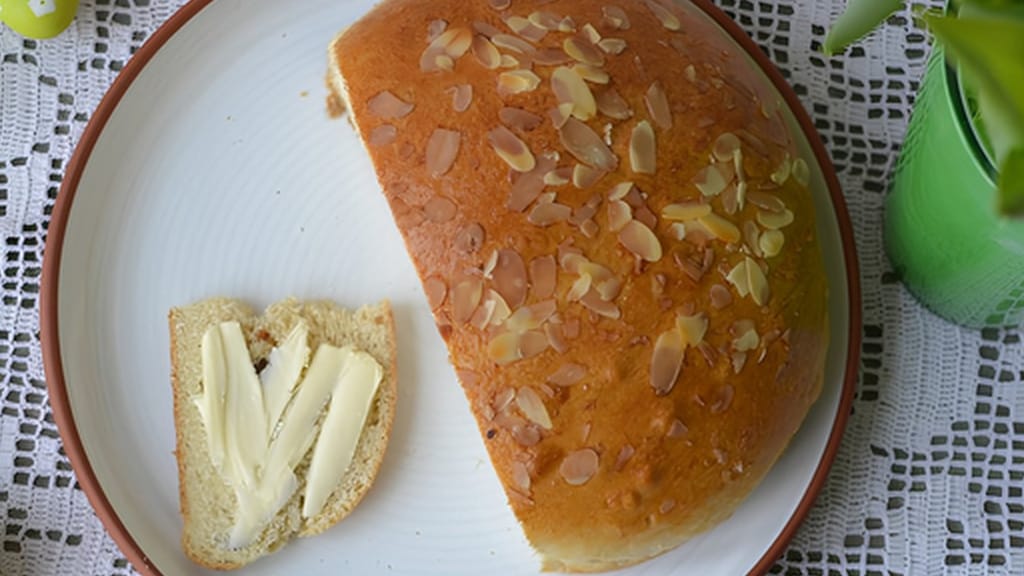
Easter classic: fragrant mazanec bread
Easter Mazanec: How to Get Fluffy Yeast Dough Without Cracks

Updated Jul 19, 2026
Easter mazanec is a sweet yeasted bread made from a rich butter dough, and it lives or dies by how well that dough is handled. Whether you're baking it for the first time or every year without fail, a fluffy, crack-free loaf isn't luck — it comes down to a handful of specific steps: strong flour, thorough gluten development, patient proofing, and the right oven temperature. This article walks you through them in order, and explains why each one matters.
Easter mazanec is a sweet yeasted bread made from a rich butter dough, traditionally round and baked on Holy Saturday — it's one of the oldest ceremonial breads in Czech tradition. It's made from the same dough as vánočka, the braided Christmas bread; the main difference is shape: mazanec stays unbraided, shaped into a round loaf with a cross scored into the top.
The oldest Czech recipes for mazanec date back to the 15th and early 16th centuries. Ethnographers say housewives baked it on Holy Saturday and carried it to church on Sunday to be blessed — the anointing is said to have given the bread its old name, later shortened to mazanec.
The round shape nods to the sun and spring, and in Christian tradition, to Christ's tomb and resurrection. The almonds and dried fruit on top symbolise abundance and new life.
The recipe varies from region to region. In Moravia, a little curd cheese goes into the dough for a softer, moister crumb; elsewhere you'll find rum-soaked raisins, almonds, or lemon and orange zest. Its closest cousin abroad is the English hot cross bun — also yeasted, spiced, and tied to Easter.
Easter classic: fragrant mazanec bread
A tried-and-tested traditional Easter mazanec recipe, step by step
A fluffy mazanec comes down to three things: strong flour with plenty of gluten, thorough kneading, and patient proofing. The method is always the same — a sponge starter, butter worked in last, kneading until smooth, and two rounds of proofing. Here it is, step by step:
The sponge starter. Stir fresh yeast into milk with a teaspoon of sugar. The milk should only be lukewarm, no more than 37°C — hot liquid kills the yeast. Leave it for 10–15 minutes to foam up; once a cap of foam forms, the yeast is active.
The flour. Reach for plain flour with a higher protein content (bread flour or strong flour for baking). Gluten is what holds the structure together in a heavy, buttery, sugary dough — something a soft, low-protein flour simply can't do.
Butter goes in last. Work the eggs and sugar into the sponge and flour, bring the dough briefly together, and only then add the softened, room-temperature butter, a piece at a time. Add the fat right at the start and it coats the flour, holding back gluten development.
Kneading. This is the step most people rush. Knead by hand for 20–25 minutes, or at least 15 minutes in a mixer with a dough hook. The finished dough should be smooth, springy and glossy — pull a small piece between your fingers and it should stretch into a thin, translucent membrane without tearing (the "windowpane test").
Proofing. Let the dough double in size somewhere warm and draught-free, ideally around 25°C — usually 1–2 hours. Once you've shaped the loaf, it needs a second, shorter proof on the baking tray — don't skip it.
Mazanec most often cracks for five reasons: underdeveloped gluten, underproofed dough, a dried-out surface before baking, too high an oven temperature, and no scoring on top. Each one has a fix:
Underdeveloped gluten → the dough is fragile and lacks elasticity, so it has nowhere to expand in the oven. Knead for 15–25 minutes, until it passes the windowpane test.
Underproofed dough → the dough tries to make up for lost growth in the oven, and the crust can't take the strain. Let it proof until a gentle finger poke springs back slowly. If it springs back instantly, it needs more time.
A dried-out surface → a dried skin hardens before baking even starts, and it can't stretch in the heat — it just cracks. Cover the dough while it proofs, or let it rise in the oven with a mug of hot water alongside.
Too high a temperature → the surface sets before the steam inside can escape, so it forces its way out through the weakest point. Bake more gently (see below).
No scoring → the traditional cross on top isn't just decoration — it's a pressure valve for steam. Score it with a sharp knife at least 1 cm deep.
A shiny, golden crust comes from three things working together: an egg wash, the right temperature, and steam in the oven. Brush the loaf before baking, start hot and drop the temperature, and keep some moisture in the oven.
Before baking, brush the mazanec with beaten egg — it gives it shine and an even golden colour. For a deeper colour, brush it twice: once after shaping and again just before it goes into the oven. An egg-free option is milk with a little sugar, which gives a subtle caramel note. Once baked, you can brush the warm loaf with melted butter and dust it with icing sugar once cooled.
Start baking hot, around 190–200°C, so a crust forms quickly. After about 10 minutes, drop the temperature to 150–170°C and finish baking — this lets the mazanec cook through in the middle without the surface burning. Baking time depends on size:
Smaller (up to 500 g of dough): about 25–30 minutes.
Medium (500–750 g): 35–45 minutes.
Larger (over 750 g): 50–60 minutes, but at a lower temperature.
You can tell it's done by tapping the bottom — it should sound hollow. For certainty, use a thermometer: the inside should read 90–96°C.
Moisture in the oven slows down the surface drying out and helps a smooth, even crust form without cracks. If your oven has a steam function, use it. Otherwise, place a small tray of water on the bottom of the oven, or lightly mist the inside with a spray bottle just before baking. The first few minutes matter most, since that's when the mazanec rises the fastest.
The basic dough takes well to plenty of variations: raisins soaked overnight in rum (so they don't burn in the oven and stay juicy), sliced almonds on top, lemon and orange zest in the dough, or a spoonful of curd cheese for a softer, moister crumb. If you like a bolder flavour, add a pinch of ground vanilla or some freshly grated nutmeg.
The same sweet yeast dough works for other Easter bakes too — try a braided Easter wreath with colourful eggs or little Easter Judases with honey and lemon zest. It's worth making a bigger batch of dough and baking several kinds at once.
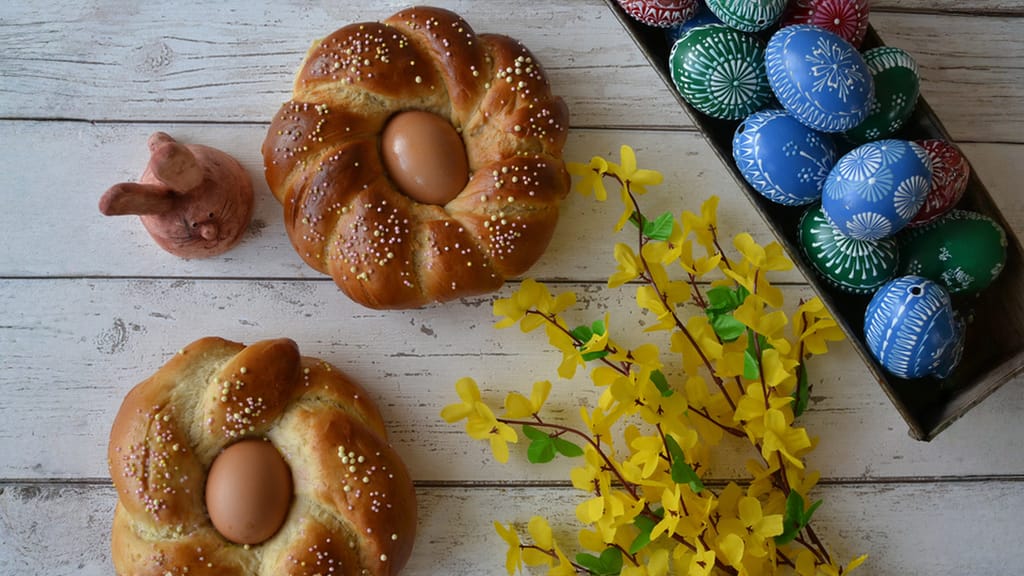
Easter wreath bread with colored eggs
An Easter wreath with colourful eggs, made from the same yeast dough as mazanec
Mazanec and vánočka are made from the same sweet yeast dough — the real difference is shape. Mazanec is a round, unbraided loaf with a cross scored into the top, while vánočka is braided from strands into a long plait. Mazanec belongs to Easter, vánočka to Christmas, but the dough and flavour are essentially identical.
A well-baked mazanec stays soft for 3–4 days if kept in a sealed container or wrapped in a tea towel and plastic at room temperature. Don't put it in the fridge — the cold makes it go stale faster. Curd cheese or butter in the dough, plus brushing the loaf with melted butter after baking, both help keep it moist.
Yes, mazanec freezes very well. Let it cool completely, wrap it in cling film, then pop it in a freezer bag — it'll keep for around 3 months. Thaw at room temperature and warm it through in the oven at 150°C for a few minutes; it'll taste almost like fresh. You can also freeze it sliced.
Yes. Dried yeast replaces fresh at roughly a 1:3 ratio — for one cube of fresh yeast (42 g) you'll need about 14 g of dried. Instant dried yeast can go straight into the flour, while active dry yeast should first be bloomed in lukewarm milk with sugar, just like fresh yeast.
A gummy crumb usually means the loaf came out of the oven too soon, or was baked at too high a temperature, so the surface browned before the inside cooked through. Bake it longer at a lower temperature (150–170°C) and go by an internal temperature of 90–96°C. It also helps not to over-wet the dough and to let it proof properly, so the crumb doesn't end up dense.
One recipe worth heating the oven for, one tip, and one deal from the shop. Nothing else.