- Season
- Available all year. Pink and red packaging tends to appear around Valentine's Day, Easter and Christmas.
- Price
- High
- Nutrition per 100 g
- 568 kcal
- 6.3 g protein
- 36.8 g fat
- 51.4 g carbs
Ruby chocolate
Baking ingredients
Ruby chocolate
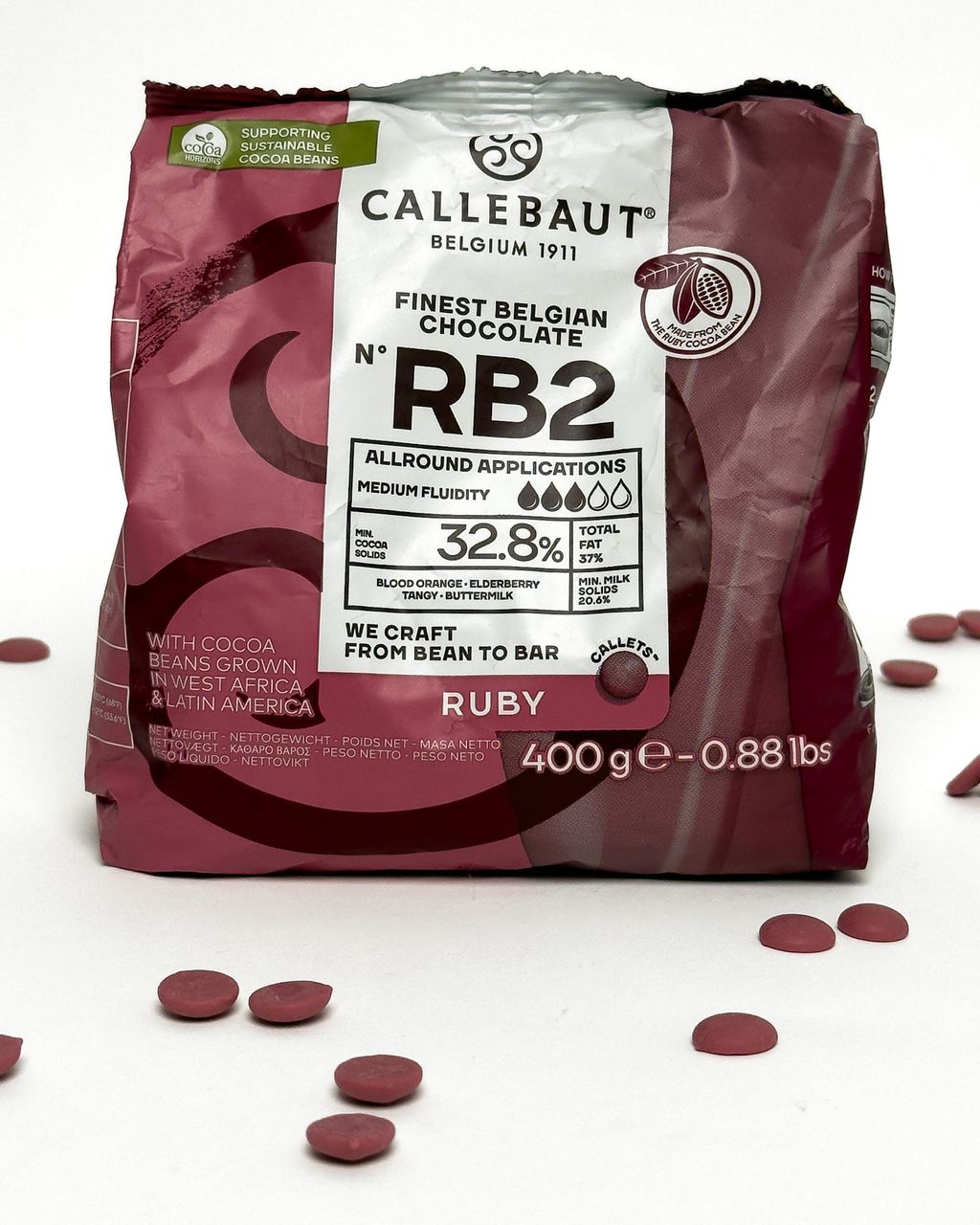
Ruby čokoláda is the pink chocolate that Czech shops sell as bars, pralines and confectioners' couverture, often as Callebaut's RB1 callets. It is made from cocoa beans processed to keep their natural pinkish colour and fruity acidity.
In practice
How to store
- On the counter
Store tightly wrapped in a cool, dry, dark place, ideally at 12–20 °C and away from strong smells. Light and air damage the pink colour faster than they damage ordinary chocolate, so keep opened callets in a sealed, opaque container. Use by the date on the pack, usually 12 months or less from production.
- In the fridge
Not recommended for long-term storage. Condensation causes sugar bloom and can dull the colour. In a hot kitchen you can store it briefly in the fridge, well sealed. Let it come to room temperature in the closed packaging before opening.
- In the freezer
Not recommended. Freezing and thawing cause condensation and bloom, and the colour may fade.
How to choose
Read the ingredient list. Real ruby chocolate gets its colour from ruby cocoa beans. It should not contain colourings such as beetroot red, carmine (E120) or fruit powders added for colour. If a 'pink chocolate' coats or contains freeze-dried fruit, that is fine, but check whether the chocolate itself is ruby or a coloured white chocolate. For baking and decorating, buy couverture callets such as Callebaut RB1. They melt evenly and temper well. For eating, choose a bar from a Czech chocolate maker or a supermarket brand. Good ruby chocolate is clearly pink, not brownish. A faded, beige or greyish-brown colour usually means it has been exposed to light, heat or moisture. A white, dusty surface is fat or sugar bloom: it is safe to eat, but the chocolate is less attractive and harder to work with.
What to swap in
Best swap
Good white chocolate with a little freeze-dried raspberry or strawberry powder. This gives a similar pink colour and fruity tartness, but it is a different product.
In a pinch
Milk chocolate with a few drops of lemon juice in a ganache, or white chocolate alone. Neither gives the colour or the full fruity tartness.
Preparation
Melt ruby chocolate gently, in a bain-marie or in the microwave in short bursts, and stir often. Keep it at or below about 40–45 °C. Overheating dulls the colour and damages the flavour. To temper, melt to 40–45 °C, cool to about 26–27 °C while stirring, then rewarm to a working temperature of about 29–30 °C. Always check the temperatures printed on the pack, because they differ slightly between products. Keep water and steam away from melted chocolate, or it will seize. Ruby colour is sensitive to moisture and alkaline ingredients. Baking soda and some alkalised cocoa can turn it greyish or brown. Long baking also dulls the colour. Ruby chocolate therefore works best in cold or barely warmed preparations, or added after baking.
Don't toss it
Tempered chocolate that has set in the bowl, failed coating and leftover drips on baking paper can all be remelted and used again. You can also stir them into ganache, shave them over desserts or melt them into warm milk for a pink hot chocolate. If the colour has faded, the chocolate is still fine for fillings where appearance matters less.
Buy it from us
In the kitchen
Cooking
Ruby chocolate is used mainly in cold or gently warmed pastry work: tempered for bonbons and moulded figures, as a coating for pralines, cake pops and strawberries, and as a glaze or drip on dorty (layered cakes). It also works well whipped into ganache for macarons and tartlet fillings, in mousses and cheesecake-style desserts, and as shavings or chips over finished cakes. As a cold decoration, it suits Czech home baking such as věnečky (choux rings), cupcakes and Christmas cukroví (small biscuits). It is not recommended for long baking or for recipes with baking soda. Heat and alkaline conditions turn the pink colour brown and mute the fruity taste.
Goes well with
- Pistachio
- Raspberry
- Strawberry
- Sour Cherry
- Lemon
- Passion Fruit
- Matcha
- Hazelnut
- Almond
- Rose
- Vanilla
- Mascarpone
- Tvaroh
- Sea Salt
What it is
Ruby čokoláda is the pink chocolate that Czech shops sell as bars, pralines and confectioners' couverture, often as Callebaut's RB1 callets. It is made from cocoa beans processed to keep their natural pinkish colour and fruity acidity. No colouring or fruit flavouring is added. The Swiss-Belgian company Barry Callebaut introduced it in 2017 and markets it as a fourth type of chocolate alongside dark, milk and white. In Czechia you will find it in two forms. Pastry suppliers and online shops sell couverture callets in 400 g to 2.5 kg bags. Czech chocolate makers and supermarkets sell finished bars, often combined with pistachios, freeze-dried fruit or nuts. Ruby chocolate is not white chocolate coloured with fruit, and it is not strawberry-flavoured chocolate. The colour and the tart taste come from the cocoa itself.
How it tastes
Ruby chocolate is less bitter than dark chocolate and less milky than milk chocolate. It tastes of red berries and has a fresh, slightly sour edge, behind a smooth, creamy melt. The cocoa flavour is mild. Most couvertures also contain a small amount of citric acid, which sharpens the tartness. The texture and sweetness are close to a good milk chocolate.
Common questions
Is ruby chocolate coloured or flavoured with fruit?
Can I bake with ruby chocolate?
How do I temper ruby chocolate?
Why did my ruby chocolate turn brown?
Is ruby chocolate vegan?
Deep dive
3 min read
Varieties
Couverture callets.
Pastry and online shops in Czechia mostly sell Callebaut Ruby RB1. According to the maker, it has about 47 % cocoa solids and about 26 % milk solids, and contains sugar, cocoa butter, cocoa mass, skimmed and whole milk powder, soy lecithin, citric acid and vanilla. It is sold in bags from 400 g up to 2.5 kg and larger.
Bars and pralines.
Czech chocolate makers and supermarket brands sell ruby bars, often with added pistachios, freeze-dried raspberries or nuts, as well as ruby pralines and seasonal figures.
Coated snacks.
Ruby chocolate also appears as a coating on almonds, freeze-dried fruit and biscuits.
Related but different products.
Pink 'strawberry' or 'raspberry' chocolate and pink candy melts are white chocolate or compound coating coloured with fruit powder or colouring. They are not ruby chocolate.
History
Barry Callebaut presented ruby chocolate in September 2017 in Shanghai. According to the company, it grew out of research into cocoa beans that began more than a decade earlier, with input from Jacobs University in Bremen. The company called it the first new type of chocolate since white chocolate. Over the following years it reached European shops in bars, confectionery and couverture, and Czech chocolate makers and pastry shops took it up for bars, pralines and cake decoration.
Science
The pink colour and fruity acidity come from compounds that occur naturally in the cocoa bean. Normal fermentation and processing turn these brown. Barry Callebaut has not fully disclosed how ruby chocolate is made. Its published patent filings describe using beans that are unfermented or only lightly fermented and treating them with acid, which keeps the pink colour. The company says the beans come from Ecuador, Brazil and Côte d'Ivoire, and that RB1 blends beans from Côte d'Ivoire, Ghana and Ecuador.
The pigments are sensitive to light, oxygen, heat, moisture and alkaline pH. This is why ruby chocolate fades to brownish over time or in baking. Like other chocolate, it contains cocoa butter that crystallises in several forms. Tempering produces the stable form, which gives gloss and snap.
In the EU, cocoa and chocolate products are regulated by Directive 2000/36/EC, which Czechia implements in national law. There is no separate legal category for 'ruby'. Products are named according to the category their composition meets, so the sales name on the label may be 'chocolate' or 'milk chocolate'. 'Ruby' appears as a descriptive or brand term.
Sourcing and ethics
Ruby cocoa is grown in the same regions as other cocoa, and raises the same issues: low farmer incomes, child labour risk in West African supply chains, and deforestation. Barry Callebaut runs its own sustainability programme, and some couvertures carry cocoa certification or sourcing claims. Look for these on the pack.
EU Regulation 2023/1115 on deforestation-free products covers cocoa and will require companies to prove that their supply chains are deforestation-free.
The main allergens in ruby chocolate are milk and soy (lecithin). Many products are made on lines that also handle nuts, so read the 'may contain' statement if you have an allergy.