- Season
- Year-round
- Price
- Low
- Nutrition per 100 g
- 335 kcal
- 85.6 g protein
- 0.1 g fat
- 0 g carbs
Powdered Gelatin (dry)
Baking ingredients
Powdered Gelatin (dry)
Powdered gelatin is a dehydrated, granular form of gelatin derived from the partial hydrolysis of collagen found in animal connective tissues, bones, and hides. This translucent, colorless, and flavorless protein serves as a versatile gelling, thickening, and stabilizing agent in both sweet and savory applications.
In practice
How to store
- On the counter
Store in original sealed packaging in a cool, dry place away from direct sunlight and humidity. Properly stored, unopened gelatin remains stable for 2-5 years at ambient temperature.
- In the fridge
Not necessary for dry gelatin, but prepared gelatin dishes should be kept refrigerated at or below 5 °C: sweet gels for 2-3 days, and savoury aspics, consommés and stock-based jellies for no more than 1-2 days, since these are low-acid, protein-rich foods that support bacterial growth. Cover tightly to prevent absorption of refrigerator odours.
- In the freezer
Not recommended for dry powder as condensation upon thawing can cause clumping. Prepared gelatin desserts can be frozen but may weep liquid and lose their smooth texture upon thawing.
How to choose
Look for unflavored gelatin from reputable brands with clear labeling of bloom strength (the higher the bloom number, the firmer the set). Standard culinary gelatin ranges from 50-300 bloom, with roughly 150-250 bloom covering most cooking applications and the higher end reserved for confectionery that must hold its shape. Choose bovine gelatin for firmer desserts and supplements, porcine gelatin for confections and marshmallows, or fish-based gelatin for kosher, halal, or pescatarian requirements. The powder should be free-flowing, pale yellow to amber in color, and have no off-odors.
What to swap in
Best swap
Agar-agar powder (use approximately half the amount of gelatin called for, as agar sets more firmly; note that agar sets at room temperature and doesn't melt in the mouth like gelatin)
In a pinch
Pectin for fruit-based applications, or carrageenan for dairy desserts—though neither replicates gelatin's unique thermoreversible properties or mouthfeel
Preparation
Always "bloom" powdered gelatin before use: sprinkle evenly over five times its weight in cold water (about 35 ml water per 7 g gelatin) and let stand for 5-10 minutes until swollen and spongy. Then gently heat (either by adding to warm liquid or microwaving briefly) until completely dissolved—never boil, as excessive heat degrades gelling power. Standard ratio is 7 g gelatin (one standard sachet) to 500 ml liquid for a soft set, or increase gelatin for firmer results.
Don't toss it
Leftover bloomed gelatin that hasn't been heated can be covered, refrigerated at or below 5 °C and remelted within 24 hours. Use trimmings from unmolded gelatin desserts to create layered parfaits, or melt and re-set with fresh ingredients. Add small amounts of gelatin to homemade stock for enhanced body and lip-coating richness.
Buy it from us
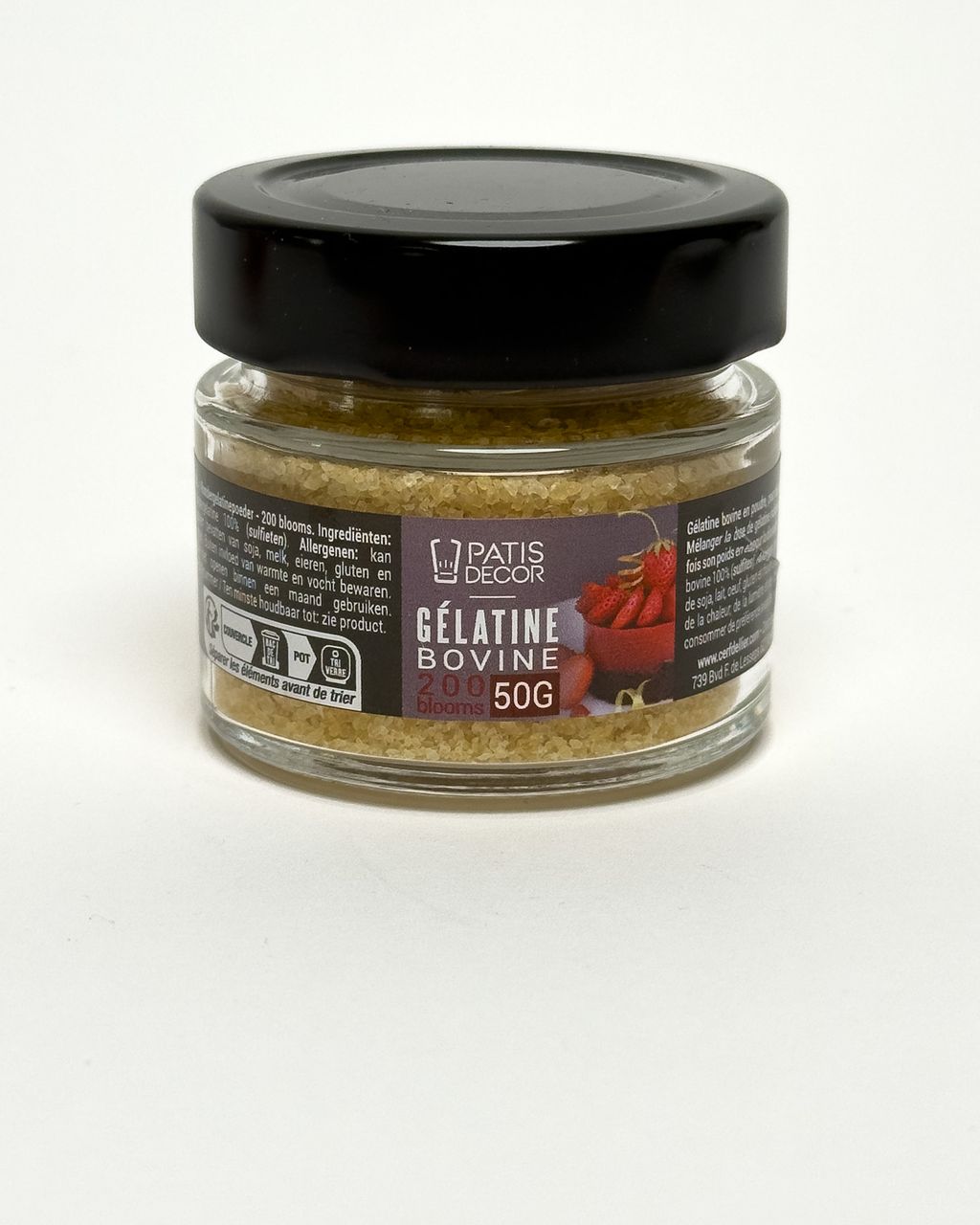
In the kitchen
Cooking
Gelatin excels in cold-set applications: classic gelées and aspics, panna cotta, Bavarian creams, mousses, marshmallows, and fruit jellies. In molecular gastronomy, it creates edible gels, fluid gels and aerated foams. Use it to stabilize whipped cream, prevent ice crystal formation in frozen desserts, clarify stocks and wines, and add body to reduced sauces. For savory applications, gelatin-enriched stocks create superior soup dumplings (xiaolongbao) and head cheese. The key is maintaining temperatures between 50-60 °C during dissolution and allowing adequate chilling time for proper gel formation.
Goes well with
- Cream and milk
- Fresh fruits (avoid raw pineapple, papaya, kiwi, and figs which contain enzymes that prevent setting)
- Sugar and honey
- Vanilla and citrus zest
- Wine and spirits
- Coffee and chocolate
- Savory stocks and consommés
- Whipped cream for mousses
What it is
Powdered gelatin is a dehydrated, granular form of gelatin derived from the partial hydrolysis of collagen found in animal connective tissues, bones, and hides. This translucent, colorless, and flavorless protein serves as a versatile gelling, thickening, and stabilizing agent in both sweet and savory applications. Unlike sheet gelatin, powdered gelatin dissolves more quickly and is easier to measure precisely for home cooking.
How it tastes
Powdered gelatin is prized for its complete neutrality—it contributes no discernible taste or aroma to finished dishes. Its magic lies not in flavor but in texture: it creates gels that melt luxuriously at body temperature, delivering that coveted "melt-in-the-mouth" sensation that distinguishes premium desserts, confections, and aspics. When properly bloomed and dissolved, it produces crystal-clear gels with a delicate wobble and silken mouthfeel.
Common questions
How do I bloom powdered gelatin properly?
Why won't my gelatin set with fresh pineapple or papaya?
What's the difference between powdered gelatin and sheet gelatin?
Is gelatin vegetarian or vegan?
How long does powdered gelatin last?
Deep dive
4 min read
Varieties
Gelatin is classified by source and processing method. Type A gelatin, produced through acid treatment of porcine (pig) skin, has an isoelectric point of 7-9 and pH of 3.8-5.5—ideal for confections and marshmallows. Type B gelatin, derived from alkaline treatment of bovine (cattle) bones and hides, has an isoelectric point of 4.7-5.4 and pH of 5-7.5—preferred for pharmaceutical capsules and firmer desserts. Fish gelatin is the usual choice where mammalian gelatin is avoided and is available with kosher or halal certification, though this depends on the individual producer's certification; it typically has lower bloom strength and a lower melting point. Bloom strength, measured on a scale from 50-300, indicates gel firmness: low bloom (50-125) for coating and glazing, medium bloom (150-200) for general culinary use, and high bloom (200-300) for confections requiring structural integrity.
History
The story of gelatin stretches back millennia—prehistoric humans discovered its adhesive properties by boiling animal bones and hides, and ancient Egyptians used collagen glue boiled from hides and bones as a woodworking adhesive, preserved in tomb furniture. Medieval and Tudor European courts prized shimmering calves'-foot jelly as a status symbol, and coloured, layered jellies ("leach" and "gelee") appear among the set-piece dishes in surviving English and French court cookery manuscripts. The scientific era began in 1679, when the French physicist Denis Papin invented his steam digester, the first pressure cooker, to extract jelly from bones. During the Napoleonic Wars (1803-1815), gelatin became a strategic food source for the French military. The modern gelatin industry emerged in the 1890s when Rousselot pioneered industrial extraction in France. In America, Peter Cooper patented "Portable Gelatin" in the mid-19th century, but it was Charles and Rose Knox who popularized gelatin cookery through their New York company, paving the way for the Jell-O phenomenon that would define American dessert culture.
Science
Gelatin's remarkable properties arise from its molecular structure—a collection of peptides and proteins derived from the triple-helix structure of collagen. When collagen undergoes partial hydrolysis, these helices unwind into individual strands rich in the amino acids glycine (about 33%), proline, and hydroxyproline. Upon cooling, these strands reform into a three-dimensional network that traps water molecules, creating a thermoreversible gel. This is the secret to gelatin's signature mouthfeel: with a melting point below body temperature (around 35 °C), gelatin gels literally dissolve on the tongue, releasing flavor in a cascade of silken luxury. The gel-sol transition is reversible — gels can be melted and reset — though repeated or prolonged heating gradually lowers gel strength, and boiling damages it outright. Certain proteolytic enzymes (bromelain in pineapple, papain in papaya, actinidin in kiwi) cleave gelatin's peptide bonds, preventing gel formation—always cook these fruits before combining with gelatin.
Sourcing and ethics
As an animal-derived product, gelatin raises considerations for vegetarians, vegans, and those following kosher or halal dietary laws. However, the gelatin industry operates within the circular economy: raw materials are by-products of the meat and fish processing industries — mainly hides, skins and bones — which also feed the leather, pet food and rendering sectors. This upcycling converts low-value raw materials into functional food ingredients while reducing environmental impact. Reputable manufacturers adhere to strict traceability standards, ISO, HACCP, and GMP certifications, and source only from facilities meeting animal welfare requirements. For those seeking alternatives, plant-based options like agar-agar, carrageenan, and pectin exist, though none perfectly replicate gelatin's unique thermoreversible properties. Fish gelatin provides an option for those avoiding mammalian products while maintaining similar functionality.