- Season
- Available year-round due to the dry nature of the crop and flour.
- Price
- Low
Calories and nutrition
per 100 g
387 kcal
Calories
22.4 g
Protein
57.8 g
Carbs
6.7 g
Fat
Chickpea flour
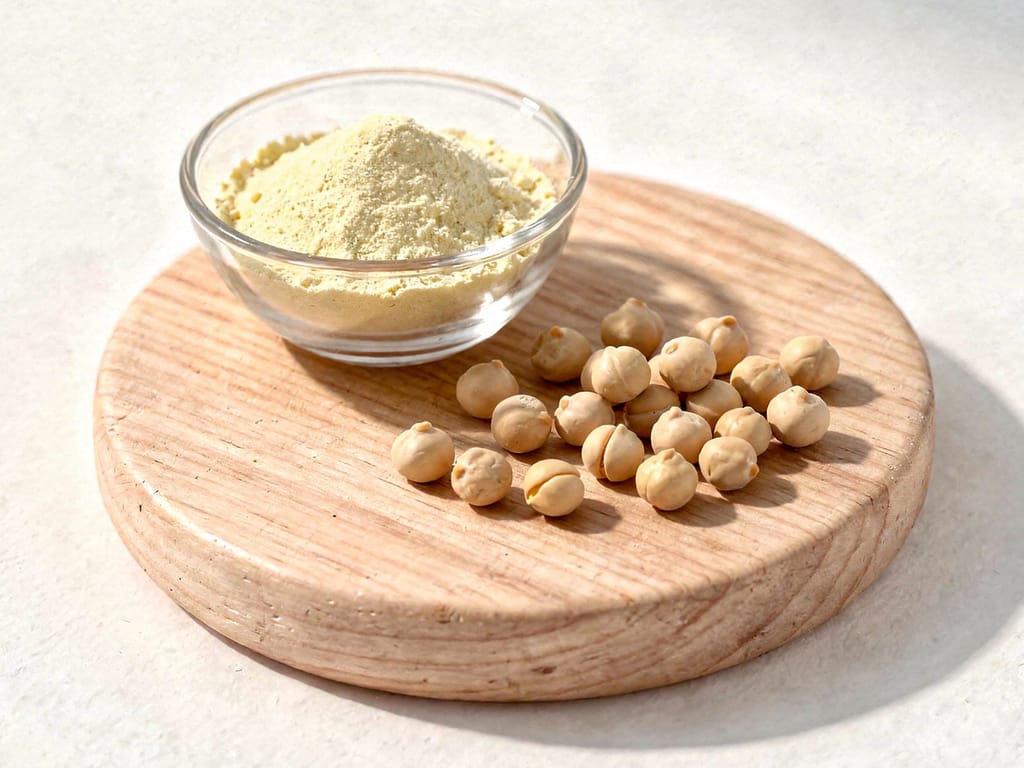
Chickpea flour is a fine powder milled from dried chickpeas, known variously as besan, gram flour, or farinha de grão-de-bico, and valued as much for its binding strength as for its discreet, leguminous depth.
per 100 g
387 kcal
Calories
22.4 g
Protein
57.8 g
Carbs
6.7 g
Fat
Store in an airtight container in a cool, dark cupboard for up to one month.
Refrigerate for up to six months to slow rancidity, particularly in warm climates.
Freeze for up to one year, well sealed, to preserve flavor and functional starches.
Select chickpea flour that is pale yellow to light gold in color, finely milled, and free from any musty aroma. Fresh flour should smell faintly sweet and nutty, never beany or stale, which indicates oxidation of the legume oils.
A blend of lentil flour and rice flour approximates both protein content and binding behavior.
All-purpose wheat flour may substitute structurally but lacks the distinctive nutty flavor and is not gluten-free.
Before use in delicate preparations, chickpea flour may be lightly toasted in a dry pan to mellow raw legume notes and deepen its aroma, a technique especially valued in Mediterranean and South Asian kitchens.
Use any excess flour as a natural thickener for soups or sauces, where its proteins and starches lend body without the need for wheat-based roux.
Roughly what a spoon or cup weighs, filled the way you usually would.
1.9 g
1 teaspoon
5.8 g
1 tablespoon
97 g
1 cup (250 ml)
Chickpea flour excels in batters, doughs, and emulsions, where its proteins coagulate under heat to create structure. It may be hydrated for fritters, steamed into set cakes, or simmered into polenta-like preparations, always benefiting from sufficient cooking to dispel raw flavors.
Chickpea flour is a fine powder milled from dried chickpeas, known variously as besan, gram flour, or farinha de grão-de-bico, and valued as much for its binding strength as for its discreet, leguminous depth.
The flavor of chickpea flour unfolds with a gentle cereal-like sweetness on the attack, followed by a broad, nutty mid-palate reminiscent of toasted hazelnut and warm legumes, and concludes with a faintly bitter, savory finish that anchors spices and aromatics rather than competing with them.
Seasonal baking plans, tested recipes and kitchen tricks that save you time. Unsubscribe in one click.
3 min read
Though often treated as a single commodity, chickpea flour expresses meaningful variation according to cultivar, terroir, and milling tradition.
Milled from small, dark-skinned chickpeas grown in semi-arid regions of India and Pakistan, this flour is typically stone-ground, yielding a slightly coarser texture. It has a pronounced earthiness and a faint bitterness that pairs naturally with robust spices. Harvested at full physiological maturity and sun-dried, the chickpeas retain dense protein matrices that give the flour exceptional binding strength.
Derived from larger, pale chickpeas cultivated around the Mediterranean basin and parts of North America, this flour is lighter in color and flavor. Roller-milled for fineness, it offers a sweeter, creamier mid-palate and a cleaner finish, making it suitable for delicate batters and custard-like preparations.
Milled in Italy from domestic or imported chickpeas, this flour is typically very finely ground, giving a silken mouthfeel prized for Ligurian farinata and Sicilian panelle.
The story of chickpea flour is inseparable from the long agricultural history of the chickpea itself, one of the earliest domesticated legumes.
Archaeological evidence places chickpeas in the diet of the eastern Mediterranean as early as 7,000 BCE. In ancient Greece and Rome, chickpeas were boiled into pottages and soups or roasted as a popular snack, valued for their satiety and ease of storage. Writers such as Athenaeus note their presence in both humble and festive tables, suggesting an early understanding of their nourishing power.
During the medieval era, chickpeas and their flour traveled along Islamic trade routes stretching from the Levant to the Iberian Peninsula, finding their way into Andalusian cooking. In the Indian subcontinent, where chickpeas had been grown since antiquity, besan was long established in temple foods and everyday sustenance. The flour’s durability made it ideal for caravan trade and military provisioning.
Industrial milling in the nineteenth and twentieth centuries standardized chickpea flour, yet regional uses persisted. Today, it occupies a renewed place in global kitchens, driven by interest in gluten-free traditions and plant-based proteins, reconnecting modern cooks with an ingredient of profound antiquity.
Chickpea flour derives its functional strength from a balanced composition of proteins, complex carbohydrates, and soluble fibers. When hydrated, its globular proteins denature and coagulate under heat, forming networks that mimic, though do not replicate, gluten structure. Its starch granules gelatinize at moderate temperatures, thickening liquids and stabilizing emulsions. The presence of saponins and phenolic compounds contributes slight bitterness, which diminishes with cooking and toasting.
Chickpeas are relatively low-impact crops, requiring less water than many protein sources and enriching soils through nitrogen fixation. Ethical sourcing favors smallholder farms in India, Turkey, and southern Europe, where traditional crop rotations preserve soil health. Consumers are encouraged to seek flour milled close to origin, reducing transportation emissions and supporting regional food economies.