- Season
- Winter to early spring, with peak quality from January through March.
- Price
- Medium
- Nutrition per 100 g
- 47 kcal
- 0.9 g protein
- 0.1 g fat
- 11.8 g carbs
Blood Orange
Fruit
Blood Orange
The blood orange is a group of sweet orange cultivars distinguished by crimson-streaked to fully ruby flesh, a coloration caused by anthocyanin pigments that develop under conditions of pronounced diurnal temperature variation. Botanically classified as Citrus × sinensis, it occupies a singular place among citrus fruits as the only widely cultivated sweet orange to express anthocyanins in the flesh itself rather than solely in peel or leaves.
In practice
How to store
- On the counter
Keep at cool room temperature for up to three days if fully ripe and intended for immediate use.
- In the fridge
Store in the crisper drawer for up to two weeks, loosely wrapped to prevent dehydration.
- In the freezer
Freeze juice or segmented flesh for up to three months, noting that texture will soften upon thawing.
How to choose
Select fruits that feel heavy for their size, indicating high juice content, with taut, finely textured skins. External coloration ranges from orange blushed with burgundy to nearly mahogany, but deeper peel color does not guarantee intense flesh pigmentation. A pronounced citrus aroma at the stem end is a reliable indicator of ripeness, while softness or dull, leathery skin suggests age.
What to swap in
Best swap
Cara Cara orange blended with a small quantity of pomegranate juice to approximate color and berry nuance.
In a pinch
Standard navel orange with a splash of cranberry juice for acidity and color.
Preparation
Wash and dry the fruit thoroughly. For raw preparations, supreme the orange to remove membranes and expose the jewel-toned flesh. For juice, extract gently to avoid excessive bitterness from the pith, particularly in smaller, highly pigmented fruit.
Don't toss it
Use untreated or organic fruit, wash well, dry the peels at low heat and grind into a fragrant powder suitable for spice blends, baking, or curing salt.
In the kitchen
Cooking
Best used raw or lightly dressed to preserve volatile aromatics and pigmentation, the blood orange also tolerates gentle heat in sauces, marmalades, and reductions. Prolonged cooking dulls both color and fragrance, shifting the flavor toward bitterness. The juice excels in vinaigrettes, granitas, and sorbets, while the zest contributes floral top notes to pastry and savory braises.
Recipes with this ingredient
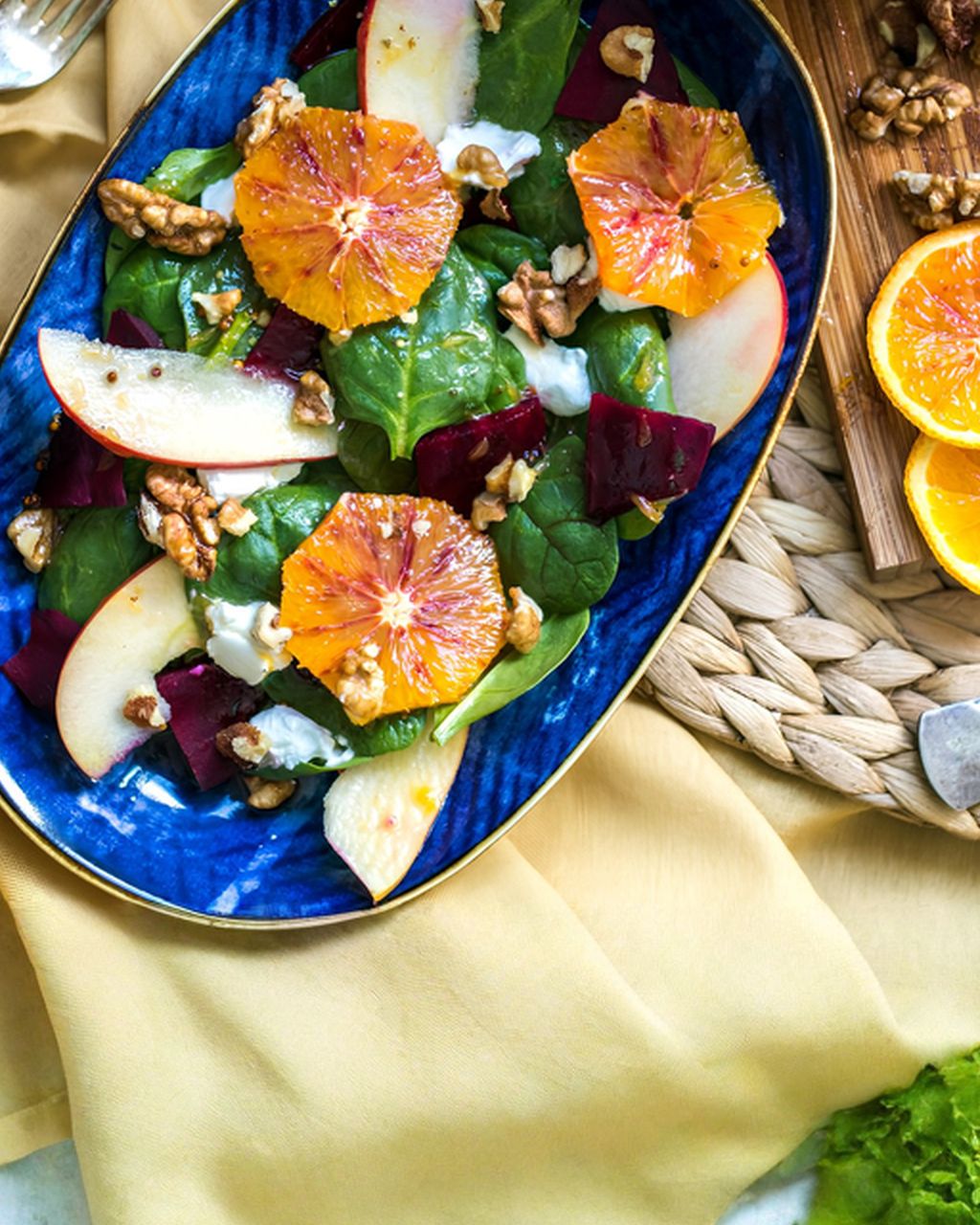
What it is
The blood orange is a group of sweet orange cultivars distinguished by crimson-streaked to fully ruby flesh, a coloration caused by anthocyanin pigments that develop under conditions of pronounced diurnal temperature variation. Botanically classified as Citrus × sinensis, it occupies a singular place among citrus fruits as the only widely cultivated sweet orange to express anthocyanins in the flesh itself rather than solely in peel or leaves. Unlike the standard blond orange, the blood orange is as much a product of climate as of cultivar. Cool nights followed by mild, sunlit days are essential to coax its characteristic pigmentation, making it inseparable from specific landscapes and seasons.
How it tastes
The attack is brisk and vinous, with a snap of acidity that recalls sour cherry and pomegranate rather than lemon. The mid-palate broadens into a supple sweetness layered with raspberry, red currant, and faint rose, supported by the familiar saccharine base of sweet orange. The finish is long, faintly bitter, and pleasantly drying, with a subtle tannic grip that distinguishes it from other dessert citrus.
Did that help? We’ll send you more tips by email.
Seasonal baking plans, tested recipes and kitchen tricks that save you time. Unsubscribe in one click.
Common questions
Why are blood oranges red inside?
How do blood oranges differ nutritionally from regular oranges?
Do all blood oranges taste the same?
Deep dive
4 min read
Varieties
Several cultivars define the blood orange category, each shaped by terroir and harvest practice. Moro: Cultivated extensively in eastern Sicily near Mount Etna, Moro develops the deepest pigmentation, often approaching purple-black at full maturity. The fruit has a faint, pleasant bitterness, and hand-harvesting in midwinter preserves acidity and aromatic intensity. Its flavor leans toward blackberry and cocoa, with a firm, tannic finish.
Tarocco
Often considered the most balanced and refined, Tarocco thrives in the same Sicilian zones but shows lighter pigmentation, typically marbled rather than solid red. Harvested from January to March, it offers exceptional sweetness, low acidity, and a lush mouthfeel. The flavor is gently berryed, with honeyed citrus notes and minimal bitterness.
Sanguinello
Common in Spain and parts of southern Italy, Sanguinello matures later, extending the blood orange season into spring. The flesh is moderately pigmented, the juice abundant, and the flavor clean and bright, with red apple and strawberry nuances. Much of the crop goes to juice production as well as the fresh market.
History
The blood orange is a comparatively recent arrival in the long chronology of citrus. In the Ancient Mediterranean world, sweet oranges were unknown; Greek and Roman writers described only sour citrus, such as citron, prized more for perfume and medicine than for eating. The genetic mutation that allows anthocyanin expression in Citrus × sinensis did not yet exist or had not been selected.
During the Medieval period, the expansion of Islamic agriculture transformed citrus cultivation. Through trade routes linking the Levant, North Africa, and Iberia, bitter and sour oranges spread widely. The sweet orange arrived later, in the 15th and 16th centuries, carried by Genoese and Portuguese traders. In Sicily, the cold winter nights and mild days of the plains around Mount Etna proved ideal for the emergence of blood oranges.
In the Modern era, written references appear in the 17th century: in 1646 the Jesuit botanist Giovanni Battista Ferrari described an orange with red-flecked flesh in his treatise Hesperides. By the 19th century, blood oranges had become an emblem of Sicilian identity and a winter luxury across Europe. Today, cultivation extends to Spain, California, and Australia, though connoisseurs continue to regard Etna-grown fruit as the archetype.
Science
The defining characteristic of the blood orange is the presence of anthocyanins, primarily cyanidin-3-glucoside. Unlike carotenoids, which color most citrus, anthocyanins are activated by cold stress. Cool night temperatures, contrasting with mild days, trigger gene expression that leads to pigment synthesis in the flesh. This explains both the seasonal nature of coloration and its inconsistency across growing regions.
Anthocyanins also contribute mild astringency. Their stability is pH-dependent, fading under prolonged heat or alkaline conditions. The balance of sugars and organic acids, chiefly citric acid, determines the perceived sweetness and structural tension on the palate.
Sourcing and ethics
Blood orange production remains largely small-scale and seasonal, particularly in traditional regions. Ethical sourcing favors growers who harvest by hand, ensuring fruit maturity and minimizing tree damage. Climate change poses a growing threat, as warmer winters reduce pigmentation and alter flavor balance. Supporting producers who maintain biodiversity, limit irrigation in water-stressed zones, and protect regional cultivars helps preserve both the sensory and cultural integrity of this fruit.