- Season
- Year-round, with cultural prominence in autumn and winter.
- Price
- Medium
- Nutrition per 100 g
- 198 kcal
- 7.6 g protein
- 17.3 g fat
- 3.4 g carbs
Sausage with Sauerkraut
Sausage with Sauerkraut
Sausage with sauerkraut is a composite dish uniting seasoned, often smoked or fresh sausages with finely shredded cabbage preserved through lactic fermentation. It is less a single recipe than a culinary framework, adaptable to local meats, spices, and fats, yet bound by the dialogue between pork richness and acidic restraint.
In practice
How to store
- On the counter
Serve immediately once cooked, as extended holding dulls both fat aromatics and acidity.
- In the fridge
Refrigerate cooked sausage with sauerkraut for up to 3 days in a sealed container.
- In the freezer
Freeze for up to 2 months, noting that cabbage texture will soften upon thawing.
How to choose
Select sausages with a coarse grind and natural casings, as these retain juiciness and textural integrity during simmering or braising. Sauerkraut should be pale gold rather than gray, with a clean, briny aroma and no sulfurous notes. Avoid kraut overly softened by pasteurization if complexity is desired.
What to swap in
Best swap
Smoked tofu or tempeh paired with sauerkraut and paprika can echo the smoky and savory balance.
In a pinch
Canned sauerkraut and pre-cooked sausages, refreshed with onion and apple.
Preparation
Sausages may be browned first to develop Maillard depth, then gently braised atop sauerkraut with aromatics such as juniper, bay, or onion. Excess acidity can be moderated with apple, white wine, or a small addition of pork fat.
Don't toss it
Use leftover sauerkraut cooking liquid to deglaze pans or enrich soups, capturing both acidity and dissolved gelatin.
In the kitchen
Cooking
Pan-searing, gentle braising, slow simmering, and oven roasting are all appropriate, with moisture controlled to prevent leaching of sausage flavor into excess liquid.
Goes well with
- Juniper
- Caraway
- Apple
- Mustard
- Dark Rye Bread
Recipes with this ingredient
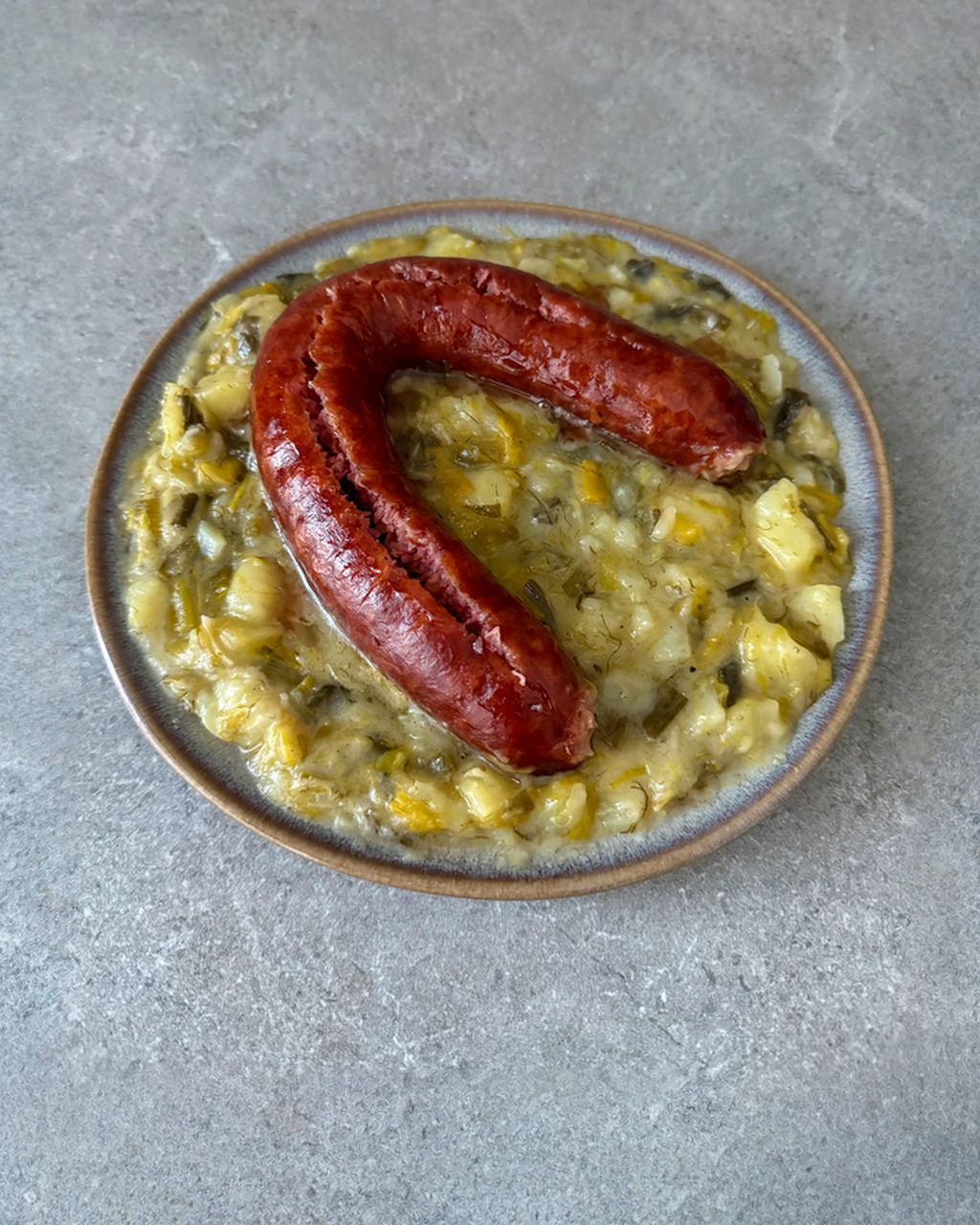
What it is
Sausage with sauerkraut is a composite dish uniting seasoned, often smoked or fresh sausages with finely shredded cabbage preserved through lactic fermentation. It is less a single recipe than a culinary framework, adaptable to local meats, spices, and fats, yet bound by the dialogue between pork richness and acidic restraint.
How it tastes
The attack is immediate and saline, driven by the sausage casing snapping to release rendered fat and spice. The mid-palate broadens with pork sweetness, garlic, and smoke, while the sauerkraut introduces lactic sharpness and vegetal depth. The finish is long, drying, and gently sour, cleansing the palate and inviting repetition.
Did that help? We’ll send you more tips by email.
Seasonal baking plans, tested recipes and kitchen tricks that save you time. Unsubscribe in one click.
Common questions
Is sausage with sauerkraut healthy?
Can sausage with sauerkraut be made without pork?
Deep dive
3 min read
Varieties
The dish manifests through regional sausages and fermentation traditions rather than rigid recipes. Alsatian choucroute garnie employs multiple pork forms, including fresh bratwurst, smoked sausages, and salted cuts, all resting on wine-scented cabbage. Bavarian iterations favor bratwurst or smoked sausages, often paired with kraut seasoned lightly with caraway, which adds a warm, aniseed-like note.
In Poland, kielbasa is paired with sauerkraut, most famously in bigos, the slow-cooked hunter's stew. Hungarian versions incorporate paprika grown in the sandy plains around Szeged, staining both sausage and cabbage a warm red and contributing a gentle bitterness. Traditionally, autumn cabbages were shredded finely to encourage even fermentation, and sausage-making followed the winter pig slaughter.
History
In the ancient era, fermented cabbage was known to Greeks and Romans as a preservation strategy for winter months, though it lacked the precise lactic control of later northern European methods. Sausages, described by Roman authors such as Apicius, were already seasoned and encased, forming an early partnership between preserved meat and vegetables.
During the medieval period, this pairing matured along central European trade routes. Salt, spices, and wine moved along the Rhine and Danube, enabling more reliable fermentation and curing. In monastic and peasant kitchens alike, sauerkraut was a winter staple that paired naturally with the pork of the autumn and winter slaughter.
In the modern era, sausage with sauerkraut became emblematic of regional identity and immigrant memory. It traveled to North America with German and eastern European settlers, where industrial meat production standardized forms, yet the dish retained its symbolic role as sustenance, celebration, and cultural continuity.
Science
The harmony of sausage with sauerkraut is rooted in biochemical contrast. Fat molecules from pork dissolve and carry aromatic compounds, while lactic acid from fermented cabbage lowers pH, enhancing salivation and flavor perception. Texture is equally important, as slow braising renders fat and dissolves some collagen from the sausages and any pork cuts into the cooking liquid, which coats the cabbage strands, producing a unified mouthfeel.
Sourcing and ethics
Responsible sourcing emphasizes pasture-raised pork with traceable feed practices and traditionally fermented sauerkraut free from chemical accelerants. Small-scale producers who allow full fermentation cycles, often four to six weeks, preserve microbial diversity and reduce reliance on preservatives. Ethical considerations also include animal welfare during slaughter and fair labor in cabbage harvests, particularly in regions where seasonal work dominates.