- Season
- Available all year; sold mostly in shops for home bakers and in pastry-supply shops, with more demand before Christmas and Easter baking
- Price
- Medium
- Nutrition per 100 g
- 521 kcal
- 9.2 g protein
- 29 g fat
- 55 g carbs
Crunchy Balls - Salted Caramel
Baking ingredients
Crunchy Balls - Salted Caramel
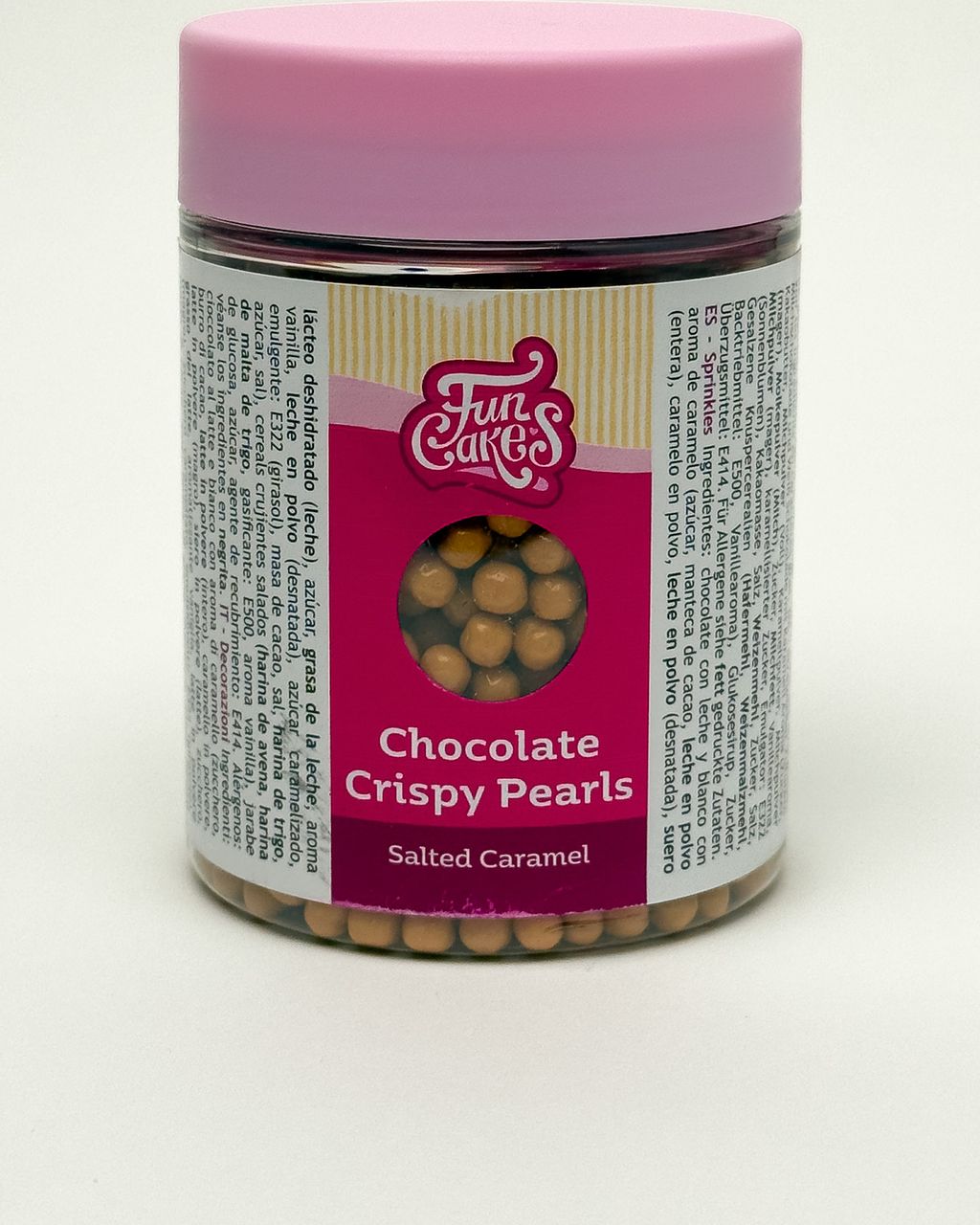
Křupavé kuličky – slaný karamel are small crunchy balls for decorating cakes and desserts: a crisp centre of puffed rice or roasted biscuit coated in caramel-flavoured white or milk chocolate with a touch of salt. Czech pastry-supply shops and online retailers sell them in small bags of about 30–100 g for home bakers and in larger bags of 500–800 g for professionals.
In practice
How to store
- On the counter
Store in a dry, cool, dark place away from strong smells. Makers give limits of up to about 25 °C, or ideally 12–20 °C with humidity below 70 %. Reseal the bag tightly after opening, or move the balls to an airtight jar, because moisture makes the centres soft.
- In the fridge
Not recommended for the bag itself. Condensation can make the coating sticky or cause sugar bloom, and the crisp centre can go soft. Decorated desserts with cream must be kept in the fridge, but add the balls as late as you can.
- In the freezer
Not recommended. Thawing causes condensation, which damages the glaze and the crunch.
How to choose
First check the size. Pearls of about 3–5 mm work as a sprinkle on cups, mousses and the sides of cakes. Maxi balls of about 1.5–1.8 cm work as single decorations placed on top of a cake or on each piped swirl of cream. Read the composition. Products described as "čokoláda s karamelem" or "bílá čokoláda s karamelem" use real chocolate. Cheaper versions may use a compound coating made with vegetable fat. The crispy centre may be extruded rice or wheat biscuit, and many products contain both wheat and milk, so check the allergen list. Choose bags that are well sealed, with whole balls and no white bloom or stuck-together clumps.
What to swap in
Best swap
Crispy pearls in a different chocolate flavour, such as milk chocolate or white chocolate, finished with a few flakes of sea salt. They give the same size and crunch.
In a pinch
Crushed caramelised biscuits or puffed rice mixed with a little melted caramel chocolate and a pinch of salt, left to set and then broken into small pieces.
Preparation
The balls need no preparation. Add them at the end, ideally shortly before serving, because contact with whipped cream, yoghurt or mousse slowly softens the centre. Larger maxi balls are light enough to sit on cream without sinking. To fix them to the side of a cake, press them into fresh buttercream or ganache that has not set yet. You can also stir the small pearls into a firm cream or chocolate mixture just before setting to add crunch, but they lose their crunch faster in wet fillings. Do not bake them. The chocolate coating melts and burns at oven temperatures.
Don't toss it
Stir leftover pearls, or ones that have gone a little soft or dull, into melted chocolate and spoon small piles onto baking paper to make quick clusters. You can also mix them into granola-style toppings for ice cream or porridge, or fold them into a chocolate tart base made with crushed biscuits and butter.
Buy it from us
In the kitchen
Cooking
Use them only as a cold decoration or inclusion. Scatter them over cupcakes and cream cakes, press them onto the sides of cakes, place maxi balls on piped cream, or use them in layered dessert cups with cream and fruit. They suit Czech home favourites such as the caramel layer cake (karamelový dort), věnečky and other cream-filled pastries, and modern mousse cakes. Stir them into ice cream or set desserts only just before serving. Do not bake, fry or boil them.
Goes well with
- Whipped Cream
- Mascarpone Cream
- Dark Chocolate
- Milk Chocolate
- Coffee
- Banana
- Apple
- Pear
- Hazelnuts
- Peanuts
- Vanilla Ice Cream
- Greek-style Yoghurt
What it is
Křupavé kuličky – slaný karamel are small crunchy balls for decorating cakes and desserts: a crisp centre of puffed rice or roasted biscuit coated in caramel-flavoured white or milk chocolate with a touch of salt. Czech pastry-supply shops and online retailers sell them in small bags of about 30–100 g for home bakers and in larger bags of 500–800 g for professionals. The best-known professional version is Callebaut Crispearls salted caramel, which are pearls about 5 mm across. Other producers make larger "maxi" balls of roughly 1.5–1.8 cm. They are a finishing touch that you scatter or place on top. They are not a caramel sweet to eat alone and not a breakfast cereal. The coating usually makes up most of the weight. In typical products the caramel chocolate is about 80–85 % and the crispy centre about 12–15 %. A shiny glaze keeps the balls from sticking together and protects them from moisture.
How it tastes
The first taste is sweet, milky caramel, similar to caramelised white chocolate or dulce de leche, with a little salt that softens the sweetness. When you bite, the thin coating breaks and the centre gives a dry, airy crunch. Rice centres taste neutral and light. Biscuit centres taste slightly toasted, like baked dough. The balls stay crunchy for a while on top of cream but slowly go soft if left in contact with moisture.
Common questions
What are křupavé kuličky – slaný karamel used for?
Will the balls stay crunchy on whipped cream?
Are they gluten-free?
Which allergens do they contain?
Can I bake them in a cake?
How should I store an opened bag?
Deep dive
3 min read
Varieties
Small pearls (about 3–5 mm).
These are sold in Czech shops by Callebaut as Crispearls and in smaller bags under pastry-supply brands. They have a crispy biscuit or rice centre coated in caramel chocolate and are used as a sprinkle and to add texture.
Maxi balls (about 1.5–1.8 cm).
These are larger, light balls of extruded rice coated in white chocolate with caramel, sold in packs of about 35 pieces per 100 g. You place them one by one on cakes and cups.
Other flavours of the same product.
Crispy balls also come in dark, milk and white chocolate, fruit-flavoured coatings and coloured sugar glazes. They are used the same way.
Different products, often confused.
Raw date balls with salted caramel flavour are energy balls you eat as a snack, not crunchy decorations. Chocolate-coated malt balls such as Maltesers are sweets eaten alone. Caramel-flavoured breakfast cereals are eaten with milk.
History
Crispy chocolate-coated pearls were developed as a professional pastry ingredient. Callebaut, a Belgian chocolate maker, sells them as Crispearls. Salted caramel became a popular dessert flavour across Europe in the 2010s, and Czech pastry-supply shops now sell salted caramel versions alongside the classic chocolate ones for home cake decorating.
Science
The crunch comes from the centre. Puffed or extruded rice, or a roasted biscuit, has a dry, porous structure with very little water, so it shatters when you bite it. The fat-rich chocolate coating acts as a barrier to moisture, and an outer glaze such as gum arabic or shellac-type glazing agents adds shine and slows the movement of water from wet creams into the centre. That barrier is not complete. In whipped cream or yoghurt, water slowly gets through, and the centre softens over hours.
The caramel flavour comes from caramelised sugar and caramelised milk ingredients in the coating. Heating sugars with milk proteins produces Maillard and caramelisation compounds with toasty, buttery notes. Added salt sharpens how sweetness is perceived. Like any chocolate, the coating can show fat or sugar bloom, a whitish film, if it is stored warm or in damp conditions. Bloomed balls are safe to eat but look dull.
Sourcing and ethics
The main ingredients that raise sourcing questions are cocoa butter and cocoa mass from the chocolate coating, mostly grown in West Africa, and milk. Some large chocolate makers, including Callebaut, run their own cocoa sustainability programmes. If certification such as Fairtrade or Rainforest Alliance matters to you, look for it on the label, because many small decoration packs do not state it. Some coatings use vegetable fats, so check the composition if you want to avoid palm oil. Under EU Regulation 1169/2011, allergens must be highlighted in the ingredient list. For these products that usually means milk, wheat or oats, and soy, plus "may contain" warnings for nuts, peanuts or other cereals.