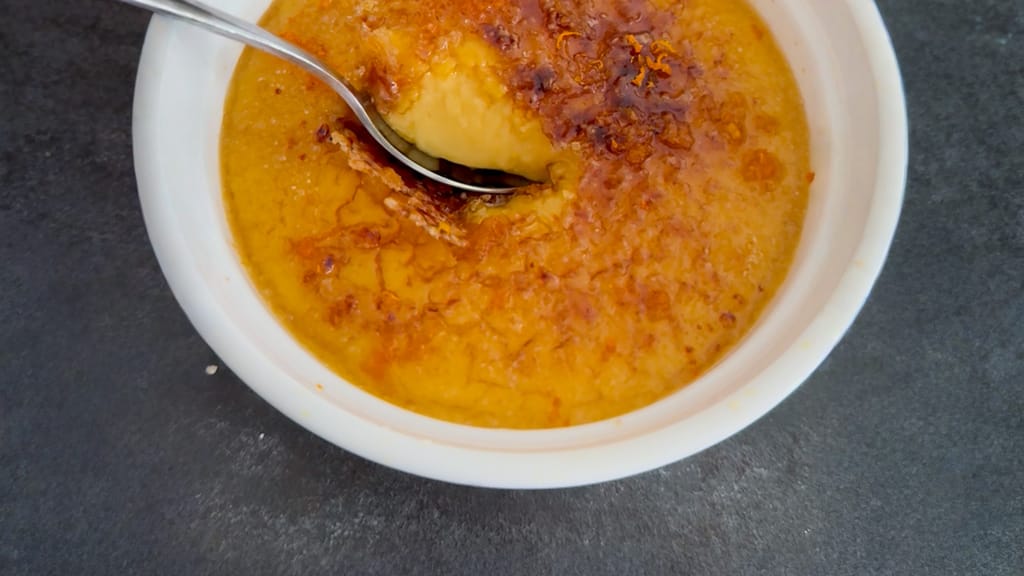
Crema catalana with orange zest and cinnamon

Updated Jul 19, 2026
Ensaimada is a fluffy, spiral-shaped pastry from Mallorca, made by stretching lard-coated dough into paper-thin layers and dusting it with icing sugar. You don't need a professional bakery to make it at home — just strong flour, patience while it proves, and one trick: the lard-slicked dough gets pulled almost see-through before it's coiled into a spiral. This guide walks you through every step, from the dough to that golden crust.
Ensaimada is a sweet, yeast-leavened pastry from Mallorca, shaped into a loose spiral and made from stretched dough brushed with lard — known in Mallorcan as saïm, which is where its name comes from. Once baked, it's crisp and golden on the outside, soft and delicately stringy inside, a bit like a pulled-apart brioche, and finished with a dusting of icing sugar.
Traditionally it comes in two forms:
Ensaïmada llisa — the plain version, with no filling, just sugar on top.
Ensaïmada de cabell d'àngel — filled with "angel hair," a sweet filling made from pumpkin-type squash strands cooked in sugar.
Since 2003, genuine Ensaïmada de Mallorca has held Protected Geographical Indication (PGI) status, having been recognised earlier, from 1996, as a specific designation. Sizes range from single-portion pastries to giant festive spirals meant for sharing.
The first written records of ensaimada date back to the 17th century, but its roots go deeper still. Historians believe the technique of stretching dough and coiling it into a spiral traces back to the centuries of Arabic presence on Mallorca — even the word saïm (lard) itself has Arabic origins.
One popular account traces its ancestry to a sweet bread made by Mallorca's Jewish community, similar to challah and kneaded with olive oil. After forced conversions, the story goes, the conversos swapped the oil for lard — richer and cheaper — giving ensaimada the flavour we know today. Legend or not, lard remains the thing that sets a true Mallorcan ensaimada apart from ordinary sweet pastry.
Ensaimada rests on just five ingredients: strong flour, sugar, eggs, yeast, and lard. No butter goes into the dough, and there's no trick to it — quality and proportions matter far more than a long ingredient list.
Flour: strong, high-protein flour (12% or more), so a stretchy gluten network can develop. Look for bread flour or strong white flour; a soft cake flour will tear when you try to stretch it.
Sugar: fine caster sugar, roughly 15–20% of the flour's weight. It dissolves smoothly and feeds the yeast at the same time.
Eggs: fresh, free-range if possible — they add colour and softness. Aim for roughly one egg per 250g of flour.
Yeast: fresh or dried. Use less than you might expect — ensaimada benefits from a long, slow rise.
Lard (saïm): soft, at room temperature, for brushing over the stretched dough. This is what creates the thin layers and that signature stringy crumb.
Lard can be swapped for soft butter or coconut oil, though the flavour and crispness will shift — butter gives a richer note, coconut a faintly exotic one. For a plant-based version, eggs can be replaced with a flax or chia "egg" (1 tablespoon of seeds plus 3 tablespoons of water per egg), though the dough will turn out somewhat denser.
Good ensaimada dough is smooth, springy, and slightly sticky — the kind that stretches thin without tearing. Keep all your ingredients at room temperature so the dough rises evenly.
Dissolve the yeast in slightly warm milk (no more than 37°C — lukewarm to the touch, never hot, or you'll kill the yeast).
Mix the flour and sugar in a large bowl and make a well in the centre.
Add the egg and yeast mixture to the well, gradually working in the flour until a rough dough forms.
Knead until smooth: 10 minutes on medium speed with a dough hook in a stand mixer, or 12–15 minutes by hand on a lightly floured surface. The dough is ready when it's springy and stretches without tearing right away, instead giving a little.
Work a small amount of lard directly into the dough for extra softness — the main layer of lard comes later, during stretching (more on that below).
Let it rise the first time: in an oiled bowl, covered with plastic wrap, at room temperature (around 25°C) for 1–2 hours, until it's doubled in size.
This is the step that turns a pastry into a true ensaimada — and it's the one most recipes leave out. Once risen, the dough is divided, and each piece is rolled into a thin sheet, generously coated with soft lard, then stretched by hand into a large, almost see-through rectangle. The goal isn't strength but patience: let the dough slide over the lard and gradually pull it outward from the edges until you can almost see the table through it.
Why this works: the thin layer of lard between the sheets of stretched dough turns into dozens of delicate layers as it bakes — that's where the pastry's signature stringy, pull-apart crumb comes from. Skip the stretching and you'll just end up with an ordinary sweet bun shaped like a spiral.
A few tips to help you get it right:
Work on a large, lightly oiled surface, not a floured one — flour slows down the stretching and dries out the dough.
Pull from the centre outward and rotate the sheet as you go, so it stretches evenly thin.
Don't worry if a hole appears — just keep going around it; it'll disappear once you roll it up.
The lard needs to be soft, like a spreadable cream, not melted; melted lard will just run off and no layers will form.
Roll the stretched sheet up along its longer side into a thin rope, then loosely coil it into a spiral. The key word is loosely: leave gaps between the coils so the dough has room to expand during the second rise without tearing.
Filled version: before rolling up the sheet, spread a thin strip of filling along the long edge (classically cabell d'àngel made from pumpkin, or a thick pastry cream). Spread it evenly, otherwise the spiral will split open in one spot.
Coiling: place the spiral on a baking-paper-lined tray and tuck the end of the rope underneath so it doesn't unravel.
The second rise takes a while: cover with plastic wrap and let it prove for 8–12 hours, overnight is fine, at room temperature, until it's nicely puffed up. This slow second rise is exactly what gives ensaimada its lightness — don't rush it.
Crema catalana with orange zest and cinnamon
Crema Catalana with Orange Zest and Cinnamon – a thick Spanish custard for filling ensaimada
Bake the ensaimada in a preheated oven at 180°C for about 15–20 minutes, until evenly golden — smaller spirals need only 10–12 minutes, large festive ones a little longer. Always preheat the oven thoroughly; a cold oven means uneven baking and a loss of that light, airy texture.
Things to watch out for:
Never brush an authentic ensaimada with egg wash. It's not meant to be shiny — instead, lightly spritz it with water or brush with a little lard before baking, and dust it with icing sugar only after baking, while it's still warm.
Go by colour, not just time. A pale spiral isn't done yet; if it's browning too fast, lower the temperature by 10–15°C or cover it loosely with foil.
Don't open the oven door in the first few minutes — the drop in temperature will deflate the freshly risen dough.
A dark baking tray conducts more heat than a light one, so keep an eye on the base if you're using one, to stop it burning.
Let the finished ensaimada cool on the tray for a few minutes before moving it — fresh out of the oven, it's fragile and can lose its shape easily.
Serve ensaimada at room temperature — that's when its softness and buttery flavour really shine, and the icing sugar on top stays put. In Mallorca, it's a classic breakfast: torn or sliced pieces of the spiral alongside a strong coffee, cappuccino, or café con leche. The sweeter filled version also pairs beautifully with unsweetened tea.
It's a pastry made for sharing — a large spiral gets broken into pieces at the table. Serve it fresh, ideally the same day it's baked, when the crust is at its crispest.
Let the ensaimada cool completely, then wrap it in plastic wrap or seal it in an airtight container so it doesn't dry out — at room temperature it's at its best for 1–2 days. Skip the fridge if you can, since it toughens pastry; if you do chill it, bring it back to room temperature or warm it briefly in the oven before serving so it softens up again.
Yes, ensaimada freezes well and keeps for several months without losing quality. Wrap it tightly in plastic wrap and place it in a freezer bag, then thaw at room temperature and warm it briefly in a low oven before serving; dust it with icing sugar only at the very end.
This usually means the gluten hasn't developed enough or the flour is too weak — the dough rips before it can be pulled thin. Knead it long enough (10–15 minutes) until it's springy, use a strong, high-protein flour, and let the dough rest a few minutes before stretching so the gluten relaxes; a small hole here and there is fine, since it disappears once the dough is rolled into a spiral.
Yes, you can swap the lard for soft butter or coconut oil, though the result won't be entirely traditional. Butter gives a richer, milkier flavour, coconut oil a faintly exotic note; both hold the layers less well than lard, so the crumb will be a touch less stringy.
The plain version, ensaïmada llisa, has no filling — it's just stretched dough coiled into a spiral and dusted with sugar. The filled version (most often with cabell d'àngel, made from pumpkin strands cooked in sugar, or sometimes pastry cream or chocolate) has the filling spread in a strip along the dough before it's rolled up, so it runs through the entire spiral.
I send one like it every week. A recipe, a tip, one deal — nothing else.